Rebar Coupler Manufacturer in Ahmedabad
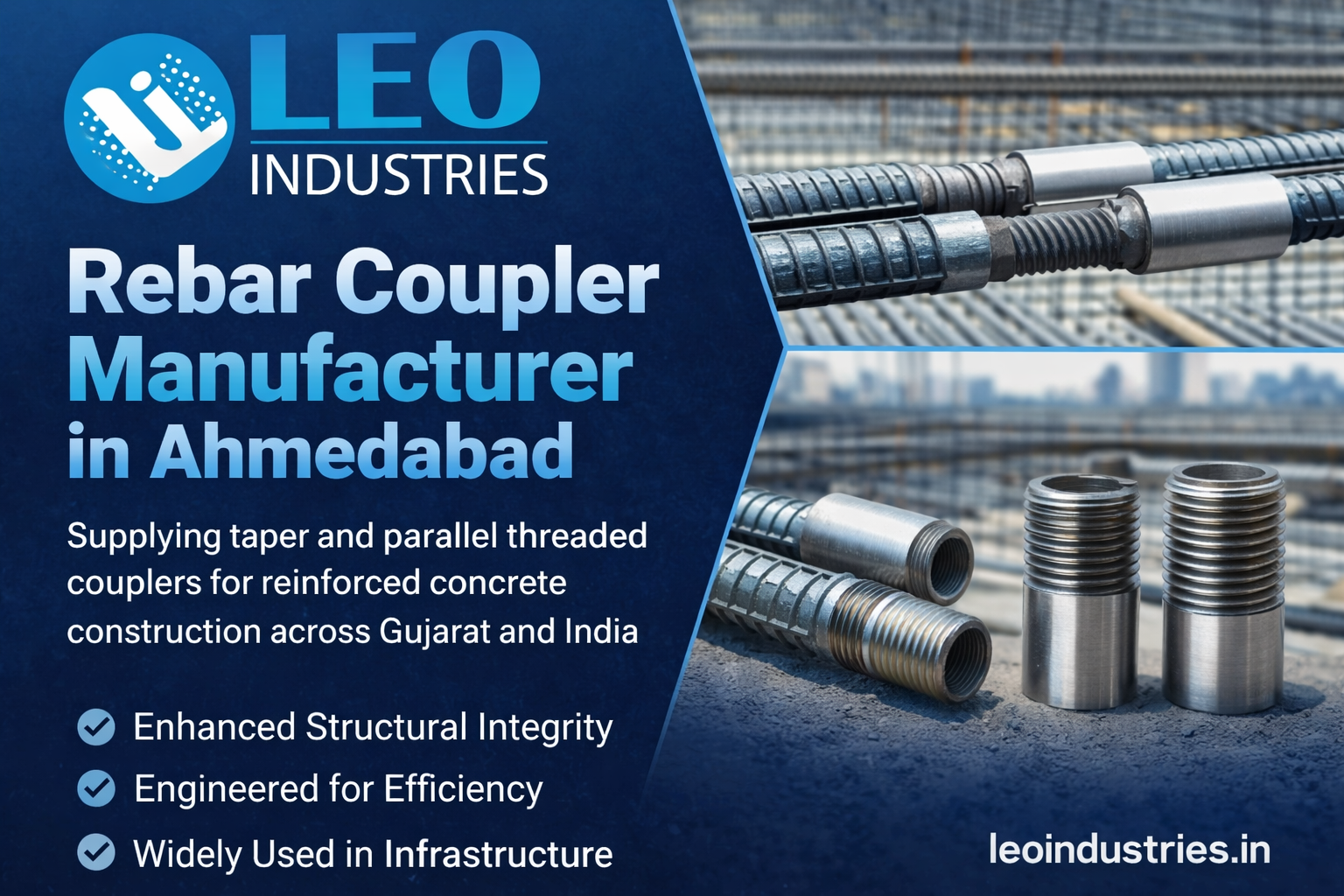
Rebar Coupler
Manufacturer
in Ahmedabad
A Rebar Coupler Manufacturer in Ahmedabad plays a significant role in supporting infrastructure growth across Gujarat and India by supplying precision-engineered mechanical connectors for reinforcing bars.
Rebar Couplers in Modern Construction
Rebar couplers have become an essential component in modern reinforced concrete construction. As structural designs grow more complex and load requirements increase, mechanical splicing solutions are steadily replacing traditional lap splicing methods.
Rebar couplers are designed to join two reinforcement bars while ensuring continuous load transfer without increasing steel congestion. Compared to lap splicing, mechanical couplers reduce material wastage, improve structural alignment, and deliver consistent joint performance. In projects where safety, structural integrity, and compliance with engineering standards are critical, selecting the appropriate coupler system directly influences long-term structural reliability.
Understanding Rebar Couplers in Reinforced Concrete Construction
Rebar couplers are mechanical devices used to connect reinforcing steel bars end-to-end. They establish a direct load path between rebars, maintaining structural continuity without overlapping steel. This enhances both structural efficiency and construction speed.
In high-rise buildings, bridges, metro pillars, flyovers, and industrial foundations, couplers are widely preferred due to space constraints and high-load demands. Mechanical splicing allows reinforcement density to remain controlled while maintaining the required tensile strength at the joint.
A key advantage of rebar couplers is their ability to transfer loads efficiently while minimizing bar congestion at connection points. This supports improved concrete flow during casting and strengthens the bond within the reinforced structure.
Types of Rebar Couplers Used in Construction
Project specifications often determine the type of coupler system required. Among the most commonly used systems are taper couplers and parallel threaded couplers.
Taper Coupler
Taper couplers use a conical thread design that enables self-alignment during installation, reducing the likelihood of misalignment. The tapered threading promotes uniform stress distribution and is well suited for dynamic load conditions, including seismic zones and heavy structural applications.
Parallel Threaded Coupler
Parallel threaded couplers feature uniform threads along the rebar end, ensuring consistent engagement and predictable mechanical performance. These couplers are commonly applied in standard construction projects where controlled alignment and reliable engagement are essential.
Both systems eliminate the need for lap splicing and contribute to structural efficiency across projects of varying scale.
Why Mechanical Rebar Splicing is Replacing Lap Splicing
Traditional lap splicing increases steel consumption and can create congestion within reinforced concrete members. Mechanical splicing using rebar couplers offers a technically advanced alternative.
Mechanical splicing provides:
- Reduced steel wastage
- Improved structural continuity
- Better concrete compaction
- Controlled load transfer
- Faster installation
In infrastructure-driven regions such as Ahmedabad and across Gujarat, mechanical rebar connectors are increasingly adopted in commercial complexes, industrial facilities, and public infrastructure projects.
Material and Engineering Considerations
High-performance rebar couplers are typically manufactured from alloy steel grades such as EN8D or equivalent materials that offer high tensile strength and durability. Precision machining ensures accurate threading and tight dimensional tolerances.
Quality manufacturing processes include controlled heat treatment, dimensional inspection, thread accuracy verification, and load testing. These procedures help ensure that couplers meet national and international standards applicable to reinforced concrete structures.
Applications of Rebar Couplers in Ahmedabad and Gujarat
Ahmedabad has experienced consistent urban and industrial development across residential, commercial, and infrastructure sectors. Mechanical rebar connectors are widely used in:
- High-rise residential buildings
- Commercial complexes
- Industrial sheds and plants
- Bridges and flyovers
- Metro rail projects
- Water treatment structures
- Heavy foundation works
In such projects, structural engineers prefer mechanical splicing systems to maintain reinforcement uniformity and reduce long-term structural risks.
Role of Precision Manufacturing in Structural Safety
The performance of a rebar coupler largely depends on thread accuracy and concentric alignment. Even minor deviations can compromise joint strength. Manufacturers focused on engineering precision use calibrated machinery and stringent inspection protocols to maintain consistency.
Uniform threading ensures full engagement between the bar and the coupler body, enabling the joint to achieve near-parent bar strength. This is especially important in seismic zones and high-load structures where joint reliability is critical.
Rebar Coupler Manufacturing in Ahmedabad
Ahmedabad has emerged as a strong industrial base for engineering and fabrication products. A Rebar Coupler Manufacturer in Ahmedabad supports regional infrastructure projects by supplying mechanical connectors to contractors, builders, and infrastructure developers.
Local manufacturing offers advantages such as reduced logistics time, accessible technical support, and improved project coordination. For contractors operating within Gujarat, partnering with a regional manufacturer can enhance supply reliability and inspection transparency.
Leo Industries, established in 2015 in Gujarat, manufactures engineering products including rebar couplers. With experience in the engineering sector, the company produces taper couplers and parallel threaded couplers for reinforced concrete construction. Based in Amraiwadi, Ahmedabad, it supplies mechanical splicing solutions for structural applications.
Installation Process of Rebar Couplers
Proper installation is essential to achieve full joint strength. The general process includes:
- Cutting rebar ends square
- Thread rolling or threading the bar ends
- Cleaning threaded surfaces
- Aligning the bars
- Tightening the coupler to the specified torque
Accurate thread rolling using appropriate machinery ensures dimensional precision and secure mechanical engagement.
Compliance and Quality Standards
Rebar couplers used in structural applications must comply with relevant IS, ASTM, or equivalent international standards, depending on project specifications. Testing procedures may include tensile strength testing, slip resistance evaluation, and cyclic load testing.
Adherence to quality standards ensures that couplers maintain structural integrity under both static and dynamic loading conditions.
Factors to Consider When Selecting a Rebar Coupler
Selecting the appropriate mechanical splicing solution depends on detailed project requirements. Engineers typically assess:
- Bar diameter compatibility
- Load-bearing requirements
- Seismic performance criteria
- Installation environment
- Applicable compliance standards
- Material grade
Careful evaluation ensures optimal structural performance and construction efficiency.
Future of Mechanical Rebar Splicing in India
As India continues expanding infrastructure under smart city and transportation initiatives, mechanical rebar connectors are expected to see broader adoption. Mechanical splicing supports faster construction timelines while reducing structural risks in large-scale developments.
In urban centers such as Ahmedabad, demand for precision-engineered rebar couplers is likely to increase alongside residential towers, metro expansions, and industrial growth.
Conclusion
Mechanical rebar splicing has significantly advanced reinforced concrete construction by providing a dependable alternative to traditional lap splicing. A Rebar Coupler Manufacturer in Ahmedabad supports regional infrastructure development by supplying taper and parallel threaded couplers engineered for structural strength and efficiency. As demand grows for durable and high-performance reinforcement systems, precision-manufactured rebar couplers continue to play a vital role in modern construction across Gujarat and India.
Frequently Asked Questions
A rebar coupler mechanically joins two reinforcing bars to ensure continuous load transfer without overlapping steel. It enhances structural performance and reduces congestion compared to traditional lap splicing.
Taper couplers use conical threads that allow self-alignment during installation, while parallel threaded couplers feature uniform threads for consistent engagement. The selection depends on project design and load conditions.
When properly installed, mechanical couplers are designed to achieve strength comparable to or greater than the parent bar. They provide controlled load transfer and minimize material wastage.
Rebar couplers are widely used in high-rise buildings, bridges, metro projects, foundations, industrial structures, and other infrastructure developments requiring strong reinforcement joints.
Quality is maintained through precision machining, thread accuracy inspection, material verification, controlled heat treatment, and load testing in accordance with applicable engineering standards.
Get In Touch
Our Blogs
- Rebar Coupler for Dam Construction
- Rebar Coupler for High Rise Buildings in Ahmedabad | Leo Industries
- TMT Coupler for Road Construction
- Rebar Coupler for Industrial Foundation
- Rebar Coupler for Precast Construction
- Rebar Coupler for Tunnel Construction
- Rebar Coupler for Metro Rail Project
- Rebar Coupler for Flyover Construction
- Rebar Coupler for Bridge Construction
- Mechanical Splicing Coupler Supplier
- Mechanical Rebar Coupler Manufacturer
- Rebar Coupler for Construction
- Buy TMT Bar Coupler in India
- Buy Rebar Coupler in India
- MBT Coupler Price in India
- MBT Coupler Supplier in India
- TMT Bar Coupler Price in India
- TMT Bar Coupler Manufacturer in India
- Rebar Coupler Supplier in India
- Mechanical Splicing vs Traditional Methods
- Reinforcement Connection Methods Explained
- Benefits of Advanced Reinforcement Technology
- Complete Guide to Reinforcement Connections
- What Is Mechanical Splicing in Construction
- Civil Construction Products Ahmedabad
- Structural Components Manufacturer Ahmedabad
- Construction Engineering Products Ahmedabad
- Reinforcement Solutions Manufacturer in Ahmedabad
- ISI Mark Rebar Coupler manufacturing company
- ISI Mark Rebar Coupler manufacturer in India
- ISI Mark Rebar Coupler manufacturer in India
- ISI Mark Rebar Coupler manufacturer in Gujarat
- ISI Mark Rebar Coupler manufacturer in Gujarat
- ISI Mark Rebar Coupler manufacturer in Ahmedabad
- ISI Mark Rebar Coupler manufacturer in Ahmedabad
- Parallel Threaded Rebar Coupler manufacturing company
- Parallel Threaded Rebar Coupler manufacturer in India
- Parallel Threaded Rebar Coupler manufacturer in Gujarat
- Parallel Threaded Rebar Coupler manufacturer in Ahmedabad
- Tapered Thread Rebar Coupler manufacturing company
- Tapered Thread Rebar Coupler manufacturer in India
- Tapered Thread Rebar Coupler manufacturer in Gujarat
- Tapered Thread Rebar Coupler manufacturer in Ahmedabad
- Rebar Reducer Coupler manufacturing company
- Rebar Reducer Coupler manufacturer in India
- Rebar Reducer Coupler manufacturer in Gujarat
- Rebar Reducer Coupler manufacturer in Gujarat
- Rebar Reducer Coupler manufacturer in Ahmedabad
- MBT Rebar Coupler manufacturing company
- MBT Rebar Coupler manufacturer in India
- MBT Rebar Coupler manufacturer in Gujarat
- MBT Rebar Coupler manufacturer in Ahmedabad
- Rebar Coupler factory in Ahmedabad
- Rebar Coupler production company
- Rebar Coupler manufacturer in Gujarat
- BIS Certified Rebar Coupler manufacturer
- ISI Mark Rebar Coupler manufacturer
- Parallel Threaded Rebar Coupler Manufacturer in Ahmedabad
- Tapered Thread Rebar Coupler manufacturer
- Rebar Reducer Coupler manufacturer
- MBT Rebar Coupler manufacturer
- Rebar Coupler manufacturer
- ISI Mark Rebar Couplers in Gujarat
- BIS Certified Rebar Coupler Supply in India
- IS 16172 Standard Rebar Coupler Supplier in Gujarat
- Class H Rebar Coupler Manufacturer in India
- ISI Mark Rebar Couplers in Ahmedabad
- IS 16172 Standard Rebar Coupler Supplier in India
- BIS Certified Rebar Coupler Supplier in Ahmedabad
- Class H Rebar Coupler Manufacturer in Gujarat
- ISI Mark Rebar Couplers Manufacturer in Ahmedabad
- BIS Certified Rebar Coupler Supplier in India
- IS 16172 Standard Rebar Coupler in Gujarat
- Class H Rebar Coupler Manufacturer in Ahmedabad
- IS 16172 Standard Rebar Coupler in Ahmedabad
- ISI Mark Rebar Couplers Supplier in Gujarat
- IS 16172 Standard Rebar Coupler Manufacturer in India
- Class H Rebar Coupler in Gujarat
- BIS Certified Rebar Coupler Manufacturer in Ahmedabad
- BIS Certified Rebar Coupler Manufacturer in India
- Class H Rebar Coupler Supplier in India
- ISI Mark Rebar Couplers Manufacturer in Gujarat
- IS 16172 Standard Rebar Coupler Supply in India
- BIS Certified Rebar Coupler in Gujarat
- ISI Mark Rebar Couplers Supplier in Ahmedabad
- Rebar Coupler for RCC Construction
- Stainless Steel Rebar Coupler
- Rebar Coupler Supplier in Gujarat
- Rebar Coupler Manufacturer in Ahmedabad
- Construction Rebar Coupler Solutions
- Rebar Coupler for Bridges and Highways
- Rebar couplers for RCC structures
- Tapered Thread Rebar Coupler
- Rebar Coupler Supplier in Ahmedabad
- Rebar coupler manufacturer in India
- Stainless Steel Rebar Coupler Manufacturer
- Parallel Thread Rebar Coupler Supplier
- Tapered Thread Rebar Coupler Manufacturer
- TMT Bar Coupler Supplier in India
- Rebar Coupler Manufacturer in Ahmedabad
- Threaded Rebar Coupler Manufacturer
- Stainless Steel Rebar Coupler Manufacturer
- TMT Bar Coupler Manufacturer in Gujarat
- Rebar Coupler Manufacturer in Ahmedabad
- Mechanical Rebar Coupler Supplier India
- Reducer Pipe Fitting PVC
- Reducer Coupling Threaded
- Reducer Coupling Pipe Fittings
- Reducer Coupler Fittings
- Reducer Coupler Manufacturer
- Reducer Coupler Steel
- Reducer coupler pvc
- Tamper proof nut bolt
- Anti vandal bolts
- Security bolt Fixings
- Countersunk Shear Bolt
- Coupler Threading Machine
- Best parallel threaded tmt rebar coupler tmt bar coupler
- Parallel threaded tmt rebar coupler tmt bar coupler
- Best mbt rebar coupler
- Surya mbt rebar coupler
- Mbt rebar coupler manufacturers
- Mbt rebar coupler price list Guide
- Rebar Coupler manufacturers in India
- Best rebar coupler taper coupler parallel threaded coupler
- Rebar coupler taper coupler parallel threaded coupler price
- Rebar coupler taper coupler parallel threaded coupler pdf
- Rebar Couplers Manufacturer & Supplier from Rajkot India
- Rebar coupler sizes
- Rebar coupler pdf
- Rebar coupler types
- Rebar Coupler Price in India
- Rebar Coupler manufacturers
- Rebar Splices & Couplers
- Parallel Threaded Coupler Manufacturer in Jodhpur
- Rebar Reducer Coupler in Kalyan
- TMT Bar Coupler Manufacturers in Navi Mumbai
- Tapered Coupler Manufacturers in Khammam
- Parallel Threaded Coupler Manufacturer in Miryalaguda
- Rebar Reducer Coupler Manufacturers in Bhusawal
- Tapered Coupler Manufacturers in Jalna
- Rebar Reducer Coupler Manufacturers in Telangana
- TMT Bar Coupler Manufacturers in Nandyal
- MBT Coupler Manufacturers in Tenali
- TMT Bar Coupler Manufacturers in Bengaluru
- Parallel Threaded Coupler Manufacturer in Raichur
- MBT Coupler Manufacturers in Tiruvottiyur
- Rebar Reducer Coupler Supply in Kerala
- Tapered Coupler Manufacturers in West Bengal
- Stainless Stee
- Metal Coupler Manufacturer in Bikaner
- TMT Bar Coupler Manufacturers in Karnataka
- MBT Coupler Suppliers in Tiruvottiyur
- MBT Coupler Suppliers in Tamil Nadu
- Parallel Threaded Coupler Manufacturer in Karnataka
- Tapered Coupler Manufacturers in Karnataka
- MBT Coupler Manufacturers in Visakhapatnam
- Rebar Coupler Manufacturers in Raichur
- Stainless Steel Coupler Manufacturers
- Tapered Coupler Manufacturers in Vellore
- Mild Steel Coupler Manufacturer
- TMT Bar Coupler Manufacturer in Kerala
- Rebar Reducer Coupler Supplier
- TMT Bar Coupler Supplier in Suryapet
- Tapered Coupler Sangli
- MBT Coupler Warangal
- Rebar Reducer Coupler Manufacturer in Palakkad
- MBT Coupler Supplier in Tamil Nadu
- Parallel Threaded Coupler Manufacturer in Thrissur
- MBT Coupler Manufacturers in Madurai
- Rebar Reducer Coupler Manufacturer in Kerala
- Tapered Couplers in Sangli
- Rebar Reducer Coupler Manufacturer in Salem
- TMT Bar Coupler Manufacturer in Tumkur
- Stainless Steel Coupler Manufacturer in Raiganj
- Parallel Threaded Coupler Manufacturer in Thane
- Rebar Reducer Coupler in Kerala
- TMT Bar Coupler Manufacturer in Raiganj
- Rebar Reducer Coupler Manufacturer in Maharashtra
- Rebar Coupler Manufacturers in Jalandhar
- Supplier Submersible Pump Impeller Sleeve Gujarat Ahmedabad
- Stainless Steel Impeller Sleeve Submersible Gujarat
- Impeller Sleeve Submersible Pump Ahmedabad
- Impeller Sleeve Stainless Steel Submersible Supplier
- Impeller Sleeve for Submersible Pump Supplier
- Submersible Pump Impeller Sleeve Manufacturer
- mbt coupler manufacturers in kadapa
- rebar reducer coupler in parbhani
- rebar reducer coupler in thrissur
- tmt bar coupler manufacturers in bhilwara
- rebar reducer couplers in dungarpur
- mild steel coupler manufacturer in kerala
- rebar coupler manufacturers in maharastra
- tapered couplers in kerala
- Finding Top MBT Coupler Manufacturers in Tiruvottriyur
- Top Rebar Reducer Coupler Manufacturers Serving Sikar
- Premium Rebar Reducer Coupler Supply in Mumbai
- rebar coupler manufacturers in tamil nadu
- mbt rebar coupler manufacturer in andhra pradesh
- mild steel coupler manufacturer in delhi
- rebar coupler manufacturers in kolhapur
- MBT Rebar Coupler Manufacturer in Kerala
- MBTC Coupler Suppliers in Karnataka
- MBTC Coupler Manufacturers in Suryapet
- Leading Rebar Reducer Coupler Manufacturers in Jodhpur
- parallel threaded coupler manufacturers in khammam
- mild steel coupler manufacturers karnataka
- tmt bar coupler manufacturer in miryalaguda
- mbt coupler manufacturers in palakkad
- mbt coupler dealers in karnataka
- mbt coupler dealers in maharashtra
- rebar reducer couplers in kerala
- Tapered Coupler Manufacturer in Kerala
- Rebar Roller Threading Machine
- Rebar Pilling Blade for Roll Threading Machine
- Rebar Rib Peeling Blade for Thread Rolling Machine
- CDRG Roller for Roll Thread Machine | High-Performance Tooling
- CDRG Rebar Roll Thread Roller – Automation Grade
- CDRG Threading Machine Supplier in Ahmedabad
- CDRG Threading Machine Supplier in Gujarat
- CDRG Threading Machine Manufacturer in Gujarat
- CDRG Threading Machine Manufacturer
- CDRG Threading Machine (Roll Threading Machine)
- CDRG Roller for Roll Thread Machine
- 20mm mbt rebar coupler manufacturer in sabarkantha
- MBT Coupler Manufacturers in Jharkhand
- parallel threaded coupler manufacturers in kalyan
- tapered coupler manufacturer in tamil nadu
- Tapered Coupler Manufacturer in Tamilnadu
- Tapered Coupler Manufacturer in Uttarakhand
- Rebar Reducer Coupler in Tamil Nadu
- Parallel Threaded Coupler Manufacturers in Maharashtra
- Mild Steel Coupler Manufacturer in Khammam
- TMT Bar Coupler Manufacturer in Satara
- Rebar Reducer Coupler Manufacturers in Mumbai
- Mild Steel Coupler Manufacturer in Sangli
- Tapered Coupler Manufacturer in Bhusawal
- Stainless Steel Coupler Manufacturer in Sikar
- TMT Bar Coupler Manufacturers in Maharashtra
- Mild Steel Coupler Manufacturer in Tiruchirappalli
- Parallel Threaded Coupler Manufacturer in Gulbarga
- Rebar Coupler Manufacturer Serving Assam & Vellore
- Rebar Coupler Manufacturer in Assam
- MBT Couplers
- 32x25mm Reducer Coupler
- 25x20mm Reducer Coupler
- 20x16mm Reducer Coupler
- Reducer Coupler
- Lock Shear Bolt
- 16mm, 20mm, 25mm Rebar Coupler
- Metal Couplers
- 32 mm EN8D Steel TMT Rebar Coupler
- 25 mm EN8D Steel TMT Rebar Coupler
- 20x16 mm EN8D Steel TMT Rebar Coupler
- Rebar Coupler Taper Coupler Parallel Threaded
- Rebar Coupler – Taper Coupler & Parallel Threaded Coupler
- 16 x 12 mm Reducer MBT Coupler
- 16 x 12 mm Reducer MBT Coupler
- 25 x 20 mm MBT Rebar Coupler
- 20mm MBT Rebar Coupler
- 12mm MBT Rebar Coupler
- 16mm MBT Rebar Coupler
- 25mm MBT Rebar Coupler
- MBT Rebar Coupler
- 16 mm EN8D Steel TMT Rebar Coupler
- 20mm EN8D Steel TMT Rebar Coupler
- 16mm EN8D Steel TMT Rebar Coupler
- Mild Steel Rebar TMT Coupler
- Rebar Coupler | Taper Coupler | Parallel Threaded Coupler
- Rebar Reducer Coupler
- Rebar Reducer Coupler
- 12MM TMT Bar Coupler
- 16MM TMT Bar Coupler
- Rebar Coupler Manufacturers in Gujarat
- Rebar Coupler manufacturers in India
- Tmt Rebar Coupler Manufacturers Near Me
- Tmt Rebar Coupler Manufacturers in India
- TMT Rebar Coupler Manufacturers in India
- 12mm TMT Bar Coupler
- Rebar Coupler Manufacturers in Rajkot
- 16mm TMT Bar Coupler
- Best TMT Rebar Coupler Manufacturers in India
- Rebar Coupler Manufacturers in Gujarat
- Top 10 TMT Rebar Coupler Manufacturers in India
- Impeller Collet Sleeve Manufacturers in India
- Top 10 TMT Rebar Coupler Manufacturers in India
- Impeller Collet Sleeve for Solar Pump
- Impeller Collet Sleeve for Solar Pump
- Impeller Collet Sleeve for Solar Pump
- Impeller Collet Sleeve Manufacturers in India
- Impeller Collet Sleeve for Submersible Pump in India
- Impeller Collet Sleeve for Submersible Pumps
- impeller collet sleeve manufacturer
- Impeller collet sleeve for submersible pump
- Impeller Collet Sleeve Price
- Impeller Collet Sleeve
- TMT Rebar Coupler Manufacturers in India
- Top TMT Rebar Coupler Manufacturers in India
- Rebar Coupler Supplier
- Rebar Coupler Manufacturers in India
- Rebar Coupler Manufacturers in Rajkot
- Rebar Coupler Manufacturers in India
- Top Rebar Coupler Manufacturers in India
- Top 10 Rebar Coupler Manufacturers in India
- Rebar Coupler Manufacturers in Gujarat
- Rebar Coupler Manufacturers in India
- Rebar Coupler Price
- Types of rebar Couplers
- Rebar Coupler Manufacturers in Hyderabad
- Steel rebar coupler manufacturers in india
- Rebar coupler manufacturers near me
- Rebar Coupler manufacturers in Rajkot
- Rebar Coupler manufacturers in gujarat
- Rebar coupler manufacturers in india
- rebar coupler manufacturers