Ultimate Guide to Premium Rebar Couplers: Applications & Benefits | Leo Industries
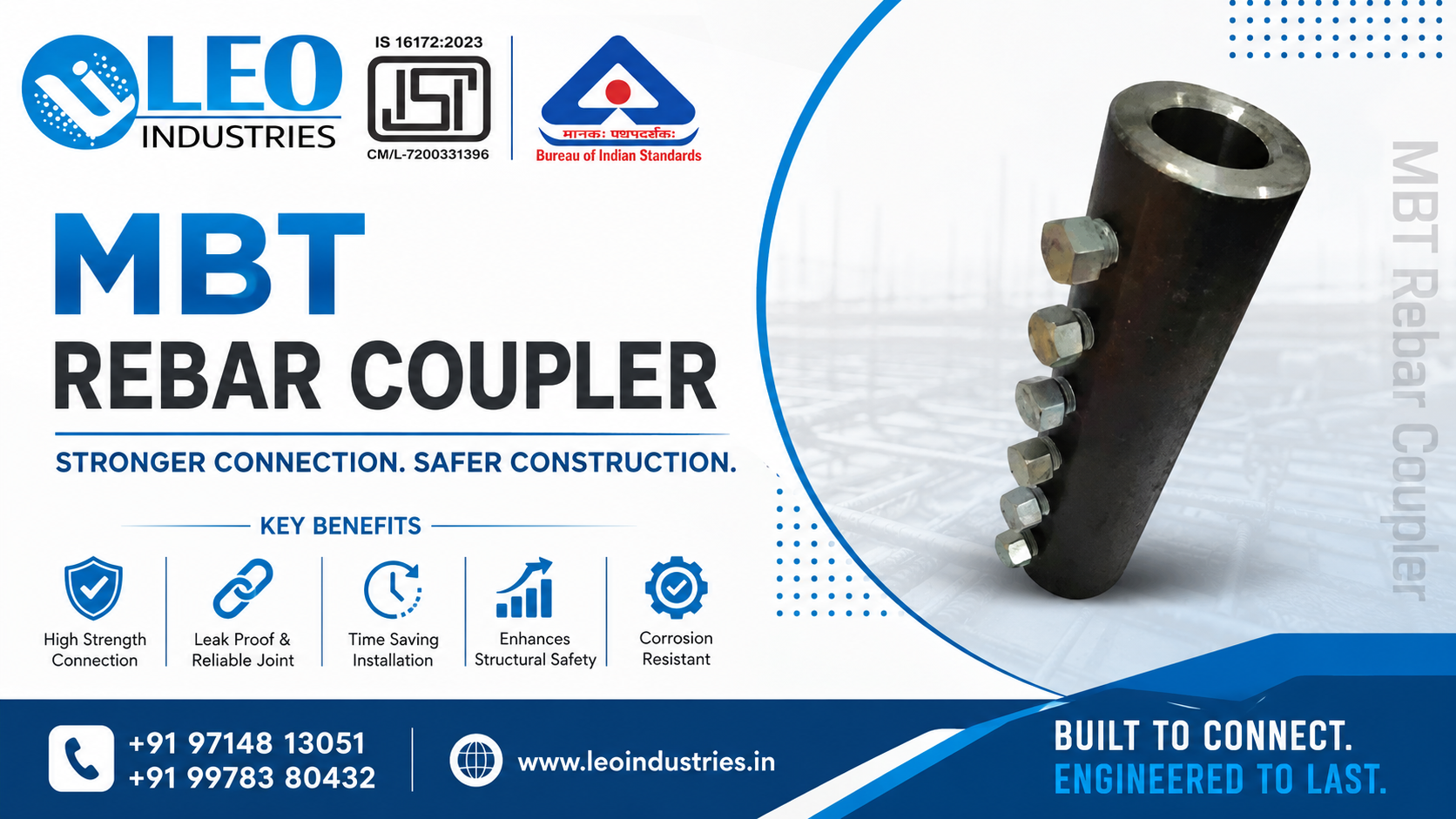
MBT Rebar Coupler manufacturer in Ahmedabad
In the rapidly evolving landscape of modern construction, ensuring structural integrity, absolute safety, and longevity is paramount. One of the most critical advancements in civil engineering and high-rise structural design is the widespread adoption of the Rebar Coupler. Replacing the traditional, material-heavy, and inherently inefficient practice of lap jointing, these precision-engineered mechanical splices offer unparalleled tension and compression performance, substantial cost-efficiency, and highly accelerated structural speed. Whether you are constructing a high-rise commercial complex, a subterranean metro station, a complex bridge pier, or a heavy-duty industrial facility, understanding the mechanics, manufacturing standards, and benefits of high-quality rebar splicing systems is essential for structural excellence.
Over the last decade, municipal building codes and national design standards have continuously tightened specifications regarding structural steel reinforcement joints. Traditional lapping practices, while familiar, present several hidden failure points, particularly under cyclic loading during seismic movements or wind-induced swaying. Standard concrete structures fail when the bond between concrete and steel degrades, leading to concrete cracking, joint slip, and catastrophic structural failure. High-quality TMT Bar Couplers solve these critical vulnerabilities by creating a single, continuous steel element, transforming segmented steel reinforcements into a robust, unified structural skeleton.
Understanding Rebar & TMT Bar Couplers
A Rebar Coupler, or TMT Bar Coupler, is a heavy-duty metallic cylinder equipped with internally machined threads, designed to join two reinforcing bars end-to-end with high structural efficiency. Historically, construction professionals relied on "lapping"—overlapping two adjacent bars and binding them together using binding wire. However, lapping creates massive concrete congestion, wastes significant amounts of steel over long spans, and relies heavily on the concrete itself for load transfer. If the surrounding concrete undergoes stress cracking or seismic micro-displacement, the lap joint immediately loses its holding capability.
Modern TMT bar couplers establish a direct, solid mechanical connection. By mechanical engagement, the structural load is seamlessly transferred from one bar to the next, entirely independent of the surrounding concrete condition. There are several categories of mechanical splices, including parallel threaded couplers, tapered thread rebar couplers, and MBT Rebar Couplers (which use shear bolts and grip sleeves for non-threaded applications). In additionally specialized scenarios, a Rebar Reducer Coupler is utilized to connect two reinforcing bars of varying diameters, ensuring that transition columns retain peak load distribution without compromise.
The Working Principle & Manufacturing Technology
The fundamental working principle of a mechanical rebar splice relies on the mechanical lock between the internal threads of the coupler and the external threads formed on the reinforcing bars. To achieve a joint that matches or exceeds the tensile strength of the parent steel, the threading process must not reduce the cross-sectional core area of the reinforcing bar. If threads are cut directly onto a standard rebar, the root of the thread becomes a weak point with a reduced core diameter, leading to premature failure under heavy tensile stresses. This critical issue is solved through advanced cold forging technology.
Cold Forging & Threading
The ends of the TMT bars undergo cold-upsetting using an industrial Rebar Forging Machine. This high-pressure cold forging process physically enlarges or "upsets" the end of the bar, increasing its diameter. When the subsequent Rebar Threading Machine cuts or rolls threads into this expanded region, the root diameter of the threaded portion remains equal to or greater than the original bar diameter, ensuring zero structural weak points.
CNC Machined Accuracy
Our couplers are manufactured on advanced Computer Numerical Control (CNC) lathe machines to guarantee dimensional micro-precision. This level of precise mechanical control prevents thread distortion, ensures proper thread pitch compatibility, and produces a highly reliable, flush fit that resists heavy dynamic tension, seismic compression, and stress-cycling without slippage.
For projects requiring fast on-site execution, our proprietary CDRG Threading Machine (Roll Threading Machine) is deployed. Equipped with high-grade, durable CDRG Threading Rollers and robust Rebar Peeling Blades, these machines peel away structural deformations and cold-roll thread profiles directly onto the upset bar ends in a single, ultra-fast sequence. This rolling method actually strengthens the material grain flow of the rebar ends, producing threads with higher load-bearing capacity than conventional cut-threads.
Key Features of Leo Industries' Couplers
Operating from our high-precision engineering workshop in Ahmedabad, Gujarat, we utilize a robust machining setup to produce rebar couplers that strictly conform to international engineering standards. Every batch is subjected to rigorous quality testing under extreme tensile loads, ensuring a mechanical performance that satisfies leading civil consultants and global safety auditors. Our products possess the following distinct characteristics:
BIS Standard Certification: Manufactured strictly adhering to Bureau of Indian Standards (BIS) norms under license IS 16172:2023 (CM/L-7200331396), which guarantees compliance with strict mechanical splice standards.
Comprehensive Material Options: We manufacture couplers utilizing premium grades of stainless steel (SS316, SS316L, SS304, SS410, SS420, SUPER DUPLEX) and high-yield mild steel/carbon steel (M.S., EN8, EN31, WPS). We also cater to customized non-ferrous engineering requirements in aluminum, copper, and nylon.
Ultimate Parallel & Taper Threading: Crafted to eliminate the risk of cross-threading during fast-paced structural execution. Parallel thread designs ensure equal stress distribution across the entire thread engagement length.
The "Bar Break" Splicing System: Engineered to achieve a high-efficiency joint that is stronger than the parent reinforcement steel itself. Under catastrophic load tests, the concrete-embedded rebar breaks outside the splice zone while the joint remains fully intact.
Prime Industrial Applications
With urbanization accelerating and structural spaces becoming more confined, mechanical splicing systems are now mandatory across massive infrastructural sectors. Leo Industries' products are designed to withstand high pressure, heavy cyclic loads, and corrosive elements, serving key infrastructure industries globally:
High-Rise Buildings & Skyscrapers
In high-rise developments, columns require a large percentage of steel reinforcement. Lapping these columns leads to severe rebar congestion. Our couplers drastically reduce steel density, permitting concrete to flow smoothly during pours and preventing critical void structures from forming.
Metros, Bridges & Flyovers
Heavy transportation infrastructure is exposed to massive dynamic fatigue and continuous vibrations. Parallel threaded couplers are crucial in flyover piers, pre-cast concrete beams, and deep metro tunnel segments to ensure consistent, highly robust joints that prevent long-term micro-shifts.
Power Plants, Marine Walls & Dams
Structures in continuous contact with water, chemical runoffs, or maritime humidity require high corrosion resistance. Splicing reinforcement steel with specialized stainless steel couplers (SS316L, Super Duplex) prevents localized oxidation and subsequent structural concrete spalling.
Core Construction Benefits
Replacing manual lapping loops with engineered couplers offers distinct economic, architectural, and operational benefits. Today's commercial, residential, and industrial builders are shifting away from traditional overlapping joints due to these key advantages:
Significant Material Savings: By eliminating lap overlaps (which often waste 40 to 60 times the diameter of the bar per joint), mechanical couplers save up to 10% to 15% of total steel consumption, yielding major financial savings in large-scale projects.
Accelerated Site Execution: Threading rebar can be done in-advance offsite. Splicing bars on-site simply requires a quick torque wrench rotation, significantly speeding up construction schedules and reducing labor overhead.
Flawless Future Extensions: When planning prospective floors or building extensions, couplers provide safe, clean connection points. Rebars are simply capped and sealed, eliminating the need to expose rusted lap steel later.
Why Choose Leo Industries?
Established in the year 2015 as a leading proprietorship firm based in Ahmedabad, Gujarat, India, Leo Industries has carved out a distinct niche as a premium manufacturer, supplier, and exporter of high-grade civil and mechanical engineering components. Founded under the visionary leadership of Mr. Mahesh Patel and Mr. Yagnesh Patel, the company has grown consistently by leveraging their extensive engineering expertise and commitment to quality.
Our modern, highly optimized 1000 sq ft infrastructural workshop in Ahmedabad is equipped with a comprehensive range of advanced precision machinery: CNC (Computer Numerical Control) Lathes, Heavy-Duty Pillar Drills, Milling Machines, Buffing Machinery, Bandsaws, Horizontal Broaching Equipment, alongside specialized Rebar Forging, Threading, and Roll-Threading Machines. While we maintain a high internal production capacity, we also collaborate with carefully vetted, registered vendors for specialized out-of-house finishing processes to deliver completed orders efficiently.
At Leo Industries, quality assurance is an uncompromised commitment. From testing incoming raw materials to certifying finished products, we ensure our mechanical splices meet the rigorous safety standards required by modern construction. Our prompt delivery and customized pricing make us a preferred engineering partner nationwide.
Frequently Asked Questions
Yes, all our rebar couplers are fully certified by the Bureau of Indian Standards (BIS) under the license IS 16172:2023 (CM/L-7200331396). This certification guarantees that our manufacturing processes, material selections, and physical tensile properties comply with Indian and international structural safety standards.
We manufacture standard and custom couplers from a wide array of premium materials. This includes high-yield carbon steels and mild steel grades like M.S., EN8, EN31, and WPS, as well as highly corrosion-resistant stainless steel variants including SS316, SS316L, SS304, SS410, SS420, and Super Duplex. For specific industrial applications, we also manufacture structural components from aluminum, copper, and engineering nylon.
Yes. To provide a comprehensive, turn-key solution on-site, Leo Industries supplies and leases high-durability CDRG Threading Machines (Roll Threading Machines), heavy-duty Rebar Forging Machines, and associated tooling. We also supply premium consumable components, such as precision CDRG Threading Rollers and custom Rebar Peeling Blades, ensuring high-speed on-site operations without downtime.
Mechanical couplers perform exceptionally well under seismic stress. Unlike overlapped joints, which can slip during dynamic reversals, our parallel threaded couplers are designed to meet structural fatigue tests. Our "Bar Break" coupling system ensures that even under catastrophic stresses, any failure occurs in the parent steel bar outside of the connection point, preserving the structural joint's integrity.
Ready to Strengthen Your Construction Projects?
Get in touch with the technical engineering team at Leo Industries for comprehensive catalogs, custom grade requirements, and competitive bulk pricing estimates.