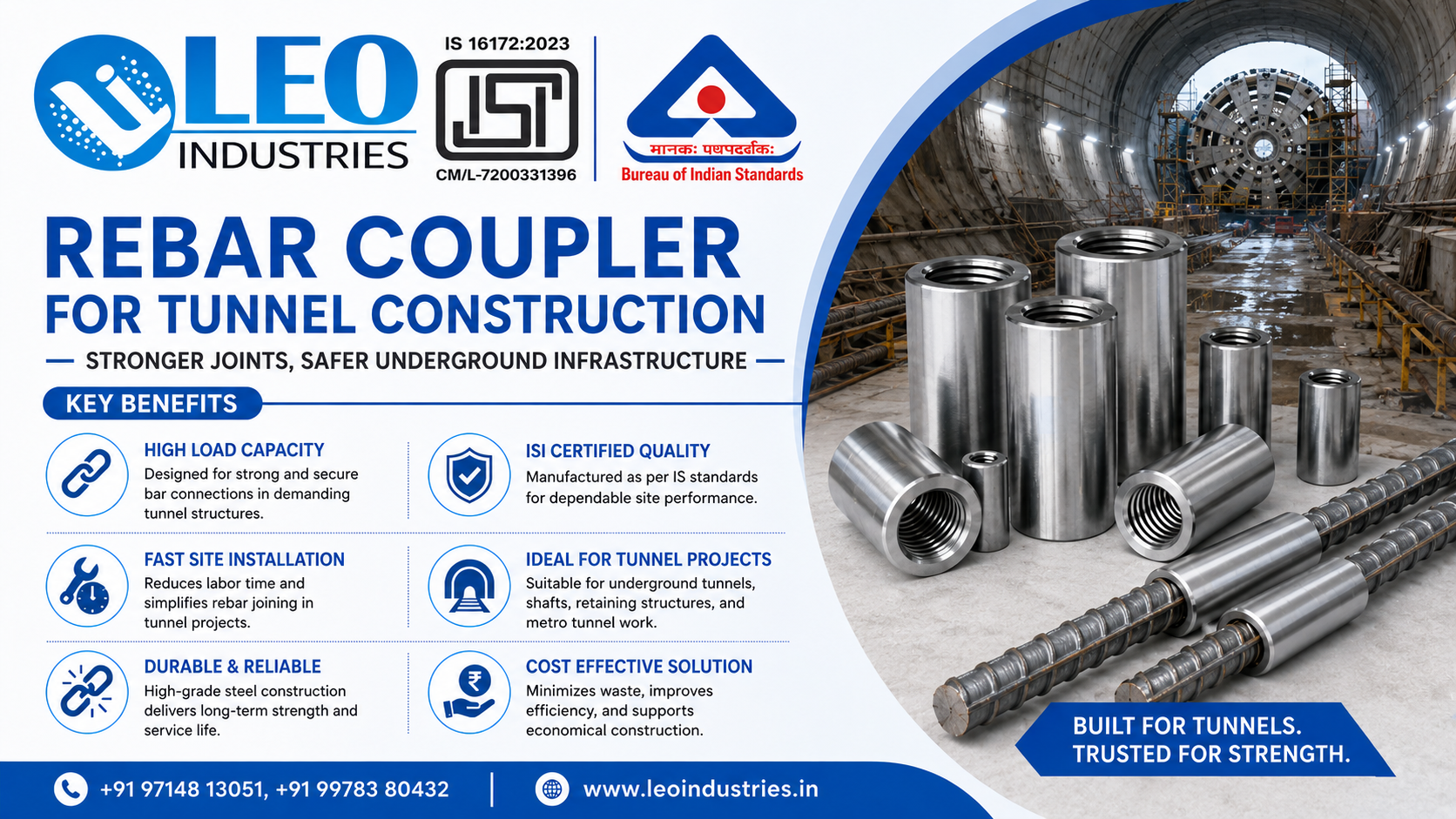
Rebar Coupler for Tunnel Construction
Discover high-strength rebar couplers for tunnel construction in Ahmedabad. Leo Industries offers reliable, compliant solutions for robust infrastructure projec
What is a Rebar Coupler for Tunnel Construction? — Overview
A rebar coupler, often referred to as a rebar splice, is a mechanical device used to join two reinforcing steel bars (rebars) end-to-end. For tunnel construction, these couplers are engineered to provide a connection that is as strong as, or even stronger than, the rebar itself. They work by creating a secure mechanical bond, typically through threading or swaging, which effectively transfers tensile and compressive forces across the splice. This eliminates the need for traditional lap splicing, which can be less efficient and require more space in congested reinforcement cages common in tunnel linings.
Key Features and Technical Specifications
When specifying rebar couplers for tunnel construction, several technical aspects are crucial for ensuring performance and reliability:
- High Tensile Strength: Capable of withstanding loads exceeding the yield strength of the rebar.
- Material Compatibility: Manufactured from materials that match or exceed the grade of the rebar being spliced (e.g., high-strength steel alloys).
- Corrosion Resistance: Especially important for underground structures, offering protection against environmental degradation.
- Ease of Installation: Designed for efficient and straightforward installation on-site, minimizing labor and time.
- Thread Type: Common types include parallel threads, taper threads, and rolled threads, each offering specific advantages.
- Load Transfer Efficiency: Ensures uniform stress distribution across the splice under various loading conditions.
- Dimensional Accuracy: Precise manufacturing ensures a tight fit and reliable connection.
- Vibration Resistance: Maintains connection integrity even under seismic or operational vibrations.
Industrial Applications and Use Cases in Tunneling
The application of rebar couplers in tunnel construction is diverse and critical for various structural elements:
- Tunnel Linings: Connecting rebars in precast concrete segments or cast-in-situ concrete linings for primary and secondary support.
- Shaft Construction: Splicing reinforcement in vertical shafts used for access or ventilation.
- Underground Stations: Reinforcing concrete structures within subterranean station platforms and access tunnels.
- Retaining Walls: Joining rebars in tunnel approach retaining walls and cut-and-cover sections.
- Cross-Passages and Adits: Connecting reinforcement in smaller tunnels linking main tunnel bores.
- Service Tunnels: Ensuring structural integrity for tunnels housing utilities and services.
- Geotechnical Anchors: Splicing reinforcement bars used in ground stabilization and anchoring systems.
- Emergency Exits: Reinforcing structures for safe and reliable emergency access routes.
How to Choose the Right Rebar Coupler for Tunnel Construction
Selecting the appropriate rebar coupler involves careful consideration of project-specific requirements and supplier capabilities. Here’s a checklist for buyers:
- Rebar Specifications: Match the coupler type and size to the diameter and grade of the rebar being used (e.g., Fe 500, Fe 550).
- Project Load Requirements: Ensure the coupler's mechanical properties meet or exceed the design loads, including seismic considerations.
- Environmental Conditions: Assess the need for corrosion resistance based on soil conditions, groundwater, and exposure.
- Installation Method: Consider the available tools, site constraints, and labor expertise for installation.
- Certifications and Standards: Verify that the couplers comply with relevant national (e.g., IS standards) and international (e.g., ISO, ASTM) quality and performance standards.
- Supplier Reputation and Experience: Choose a manufacturer with a proven track record in supplying critical construction components.
- Technical Support and Customization: Inquire about the availability of technical assistance and the ability to provide custom solutions if needed.
- Lead Time and Supply Chain Reliability: Confirm that the supplier can meet project timelines for timely delivery.
Quality Standards and Compliance
For tunnel construction, adherence to stringent quality standards is non-negotiable. Rebar couplers must meet specifications outlined in Indian Standards (IS) such as IS 1608 for mechanical testing of steel products and relevant codes for concrete reinforcement. International standards like ISO 15835 (for mechanical splicing devices) and ASTM A615/A706 (for reinforcing steel) also provide benchmarks for performance. Buyers should always request and verify manufacturer certifications, test reports, and compliance documentation to ensure the couplers are fit for purpose and will perform reliably under the demanding conditions of tunnel construction.
Why Leo Industries' Experience and Capability Matter
Established in 2015 in Ahmedabad, Gujarat, Leo Industries has built a strong foundation in manufacturing high-quality rebar couplers. Our experience spans a wide range of materials, including various stainless steel grades (SS316, SS316L, SS304) and mild steel grades (M.S., EN8, EN31), ensuring compatibility with diverse rebar types. Our manufacturing facility is equipped with advanced machinery, including CNC machines, rebar threading machines, and roll threading machines, enabling precision and efficiency.
We understand the critical nature of tunnel construction and the need for reliable splices. Our team's expertise in engineering and quality control ensures that every coupler leaving our facility meets rigorous standards. We are committed to providing solutions that enhance structural integrity and facilitate efficient construction processes for projects in Ahmedabad and beyond.
Installation, Maintenance, and Care Tips
Proper installation and care are vital for the performance of rebar couplers in tunnel construction.
- Pre-Installation Checks: Ensure both the rebar ends and the coupler threads are clean, free from debris, and undamaged. Inspect for any manufacturing defects.
- Thread Engagement: For threaded couplers, ensure full thread engagement. Hand-tighten first to check for cross-threading, then use appropriate tools for final tightening as per manufacturer specifications.
- Torque Specifications: If torque is specified, use calibrated torque wrenches to achieve the correct tightness without over-stressing the components.
- Environmental Protection: During construction, protect installed couplers from excessive moisture, dirt, and potential damage.
- Regular Inspections: Periodically inspect the reinforcement cage and couplers during the construction phase to ensure integrity.
- Material Handling: Store couplers properly to prevent damage, corrosion, or contamination before installation.
Frequently Asked Questions
The primary function is to mechanically join two reinforcing steel bars end-to-end, creating a splice that is as strong as the rebar itself. This ensures the continuity of reinforcement and the structural integrity of the concrete elements within the tunnel.
Rebar couplers offer several advantages over lap splicing in tunnel construction. They reduce congestion in reinforcement cages, allow for continuous pouring of concrete, and provide a more predictable and reliable load transfer, especially in high-stress areas.
Threaded couplers (parallel, taper, or rolled threads) are commonly used due to their ease of installation and high tensile strength. The specific type depends on project requirements, rebar size, and installation conditions.
Yes, Leo Industries manufactures rebar couplers that are designed to meet or exceed relevant Indian Standards (IS) for mechanical splicing devices and reinforcing steel, ensuring compliance and reliability for construction projects.
The material of the coupler must be compatible with the rebar grade and suitable for the tunnel's environment. For instance, stainless steel couplers offer superior corrosion resistance in damp or aggressive soil conditions, crucial for long-term durability.
When properly selected, installed, and protected, rebar couplers are designed to last for the entire service life of the tunnel structure, which can be many decades. Their lifespan is intrinsically linked to the durability of the surrounding concrete and the environmental conditions.
Conclusion
For tunnel construction projects in Ahmedabad and across Gujarat, the selection and application of rebar couplers are critical for ensuring structural integrity, safety, and long-term performance. Understanding the technical specifications, compliance requirements, and the specific demands of tunneling environments is essential. Leo Industries, with its established experience in manufacturing high-quality rebar couplers from various materials and its commitment to precision engineering, offers reliable solutions tailored to the rigorous needs of modern infrastructure development. Partnering with an experienced manufacturer like Leo Industries ensures that your tunnel projects are built on a foundation of dependable reinforcement.
Get In Touch
Leo Industries