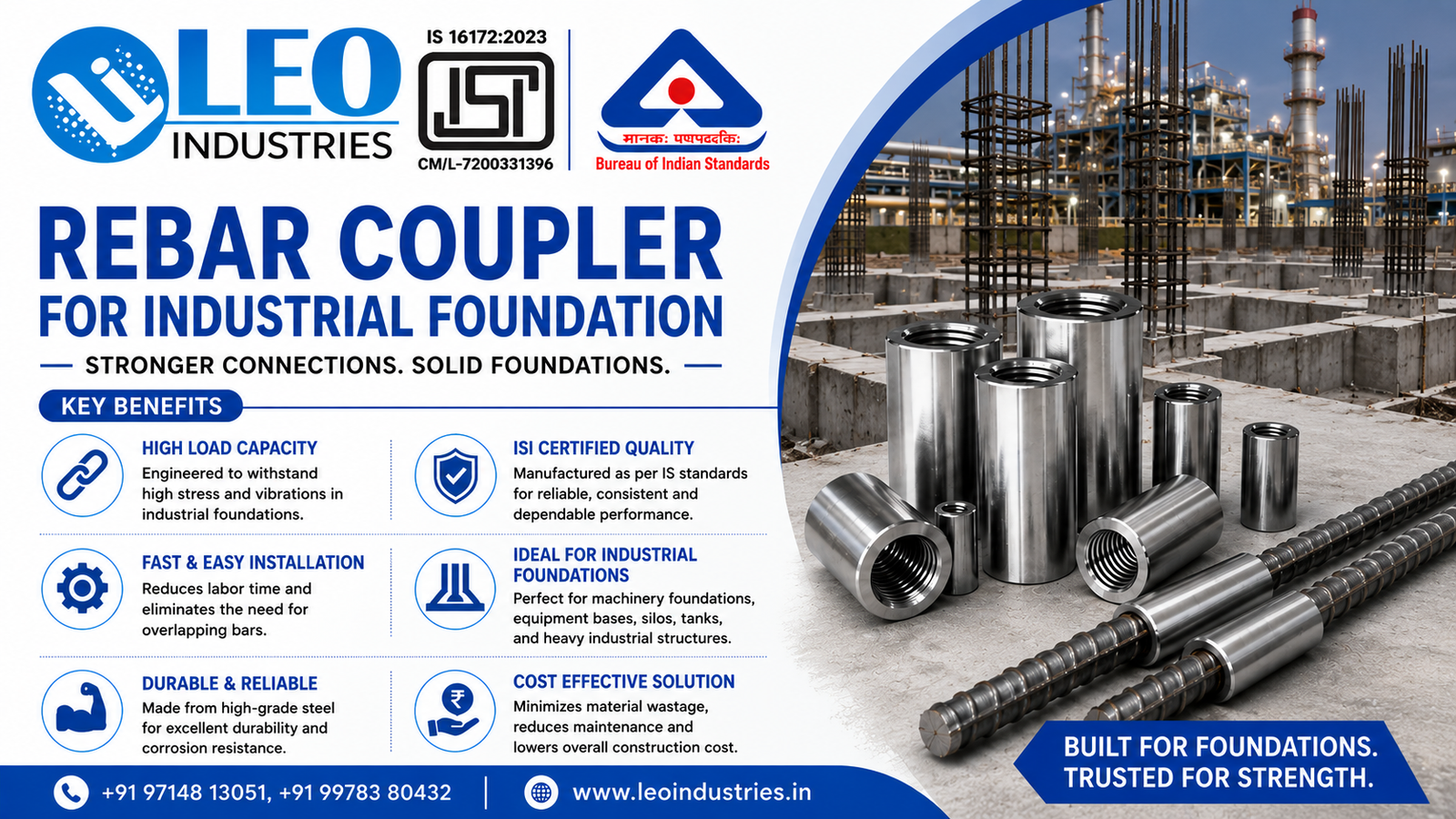
Rebar Coupler for Industrial Foundation
Discover robust rebar couplers for industrial foundations in Ahmedabad. Leo Industries offers reliable, high-strength solutions for your construction needs.
What is a Rebar Coupler? An Overview
A rebar coupler, also known as a rebar splice or connector, is a mechanical device used to join two reinforcing steel bars end-to-end. Instead of overlapping the bars (lap splicing), which requires a longer overlap length and uses more steel, couplers provide a direct, positive connection. They work by threading onto the ends of the rebars, which are typically prepared with matching threads. Once tightened, the coupler effectively creates a continuous, strong steel member, transferring tensile and compressive forces across the splice. This method ensures that the full tensile strength of the rebar is maintained, a critical factor in load-bearing industrial foundations.
Key Features and Technical Specifications
Rebar couplers are engineered for strength and reliability. Key features and specifications to consider include:
- Material: Typically manufactured from high-grade steel (e.g., carbon steel, stainless steel) to match or exceed the strength of the rebar being joined.
- Thread Type: Available in parallel thread, tapered thread, or other specialized thread forms designed for secure engagement and high tensile strength.
- Tensile Strength: Designed to achieve a minimum of 110% of the characteristic yield strength of the rebar, as per international standards.
- Corrosion Resistance: Materials and coatings are selected to provide adequate protection against environmental degradation, especially important for long-term structural integrity.
- Ease of Installation: Designed for straightforward installation with standard tools, minimizing labor time and complexity on-site.
- Bar End Preparation: Requires specific preparation of the rebar ends, usually threading, to ensure proper engagement with the coupler.
- Size Range: Available in various sizes to accommodate different rebar diameters commonly used in industrial construction.
- Load Transfer Capability: Engineered to efficiently transfer both tensile and compressive loads across the splice.
Industrial Applications and Use Cases
The robust nature of rebar couplers makes them ideal for a wide array of demanding industrial applications:
- High-Rise Industrial Buildings: Ensuring continuous reinforcement in multi-story factories and warehouses.
- Bridges and Overpasses: Providing reliable splices in bridge decks and supporting structures that experience heavy traffic loads.
- Power Plants: Critical for the structural integrity of foundations and containment structures in thermal, nuclear, and renewable energy facilities.
- Offshore Structures: Used in marine environments where corrosion resistance and high strength are paramount for platforms and substructures.
- Tunnels and Mining: Facilitating continuous reinforcement in tunnel linings and underground structures subjected to significant ground pressure.
- Large-Scale Infrastructure Projects: Essential for dams, canals, and large water treatment plants requiring long-term durability.
- Precast Concrete Elements: Enabling strong, reliable connections in precast beams, columns, and wall panels for industrial facilities.
- Seismic Zone Construction: Providing enhanced ductility and strength in areas prone to earthquakes, crucial for industrial safety.
How to Choose the Right Rebar Coupler
Selecting the appropriate rebar coupler is crucial for the success of your industrial foundation project. Consider these factors:
- Rebar Diameter and Grade: Ensure the coupler is designed for the specific diameter and grade of rebar you are using.
- Type of Load: Determine if the application requires high tensile strength, compressive strength, or both, and choose a coupler rated accordingly.
- Environmental Conditions: For corrosive environments, opt for stainless steel or specially coated couplers.
- Installation Requirements: Evaluate the ease of installation and the specialized tools or rebar preparation needed.
- Compliance and Certifications: Verify that the couplers meet relevant national and international standards (e.g., ISO, ASTM, BIS).
- Supplier Reputation and Experience: Choose a manufacturer with a proven track record in producing high-quality, reliable couplers.
- Project Specifications: Always adhere to the specific requirements outlined in your project's structural design and engineering plans.
- Cost-Effectiveness: While strength is key, consider the overall cost, including installation labor and material savings compared to lap splicing.
Quality Standards and Compliance
For industrial foundations, adherence to stringent quality standards and compliance with relevant codes is non-negotiable. Reputable rebar coupler manufacturers will ensure their products meet or exceed standards such as:
ISO Standards: For quality management systems and product specifications.
ASTM Standards: Particularly ASTM A615 for deformed and plain carbon-steel bars, and ASTM A1034 for mechanical splices.
BIS Standards (Bureau of Indian Standards): Relevant Indian standards for steel reinforcement and splicing systems.
International Building Codes (IBC) and local building regulations: Ensuring compliance with structural design and safety requirements.
Buyers should always request documentation, test reports, and certifications from the supplier to verify that the couplers are manufactured to the specified standards and are suitable for the intended load-bearing capacity of the industrial foundation.
Why Leo Industries' Experience and Capability Matter
Established in 2015 in Ahmedabad, Gujarat, Leo Industries has developed significant expertise in manufacturing high-quality rebar couplers. Our foundation is built on the vast experience of our founders, Mr. Mahesh Patel and Mr. Yagnesh Patel, who bring deep knowledge of engineering products to our operations. We understand the critical role these components play in industrial construction, where failure is not an option.
Our manufacturing process utilizes advanced machinery, including CNC machines, rebar threading machines, and roll threading machines, ensuring precision and consistency. We work with a wide range of materials, from various stainless steel grades to mild steel, aluminum, and copper, allowing us to tailor solutions to specific project needs. Our commitment to quality assurance involves rigorous checks at every stage, from material sourcing to final product inspection. This dedication ensures that every rebar coupler leaving our facility is reliable and performs to the highest standards, providing the strength and durability essential for industrial foundations in Ahmedabad and beyond.
Installation, Maintenance, and Care Tips
Proper installation is key to realizing the full potential of rebar couplers. While specific instructions vary by coupler type, general best practices include:
- Rebar End Preparation: Ensure rebar ends are clean, free from rust or damage, and accurately threaded according to the coupler's specifications. Consistent thread quality is crucial.
- Torque Application: For threaded couplers, apply the specified torque using appropriate tools to ensure a secure and tight connection without over-stressing the components.
- Inspection: Visually inspect each splice after installation to confirm proper engagement and alignment.
- Storage: Store couplers in a dry, protected environment to prevent corrosion or damage before installation.
- Handling: Handle couplers with care to avoid damaging the threads, which could compromise their ability to form a strong splice.
- Environmental Protection: In highly corrosive environments, consider additional protective coatings or sealants around the splice area as per project specifications.
Regular maintenance of industrial structures is also important. While couplers themselves are designed for the lifespan of the structure, periodic inspections of the overall foundation integrity can identify any potential issues related to the surrounding concrete or environmental factors.
Frequently Asked Questions
The primary function is to mechanically join two reinforcing steel bars end-to-end, creating a continuous steel member. This ensures efficient transfer of tensile and compressive loads across the splice, which is critical for the structural integrity and load-bearing capacity of heavy-duty industrial foundations.
Rebar couplers offer several advantages over lap splicing for industrial applications. They eliminate the need for extensive overlap, saving steel material and reducing congestion in heavily reinforced areas. Couplers also provide a more consistent and predictable splice strength, are less sensitive to rebar placement errors, and can facilitate faster construction.
Projects requiring high structural integrity, such as bridges, high-rise industrial buildings, power plants, tunnels, and seismic-resistant structures, benefit significantly. Any application where reliable, high-strength rebar connections are essential for long-term performance and safety is a prime candidate.
Rebar couplers are designed to work with various types and grades of steel reinforcement bars. However, it's essential to match the coupler type and size precisely to the specific rebar diameter and grade being used, ensuring compatibility for optimal performance.
In India, look for couplers that comply with relevant Bureau of Indian Standards (BIS) and international standards like ISO and ASTM. Manufacturers should provide documentation and test certificates to verify compliance with specified strength and performance requirements for industrial applications.
Leo Industries employs stringent quality control measures throughout the manufacturing process. This includes using high-grade raw materials, precision machining on advanced equipment, and thorough testing of finished products to ensure they meet or exceed industry standards for strength, durability, and reliability.
Conclusion
For industrial foundations in Ahmedabad, the choice of rebar splicing method directly impacts structural integrity, construction efficiency, and long-term performance. Rebar couplers offer a superior solution to traditional lap splicing, providing robust, reliable connections essential for the demanding loads and environments of industrial construction. By understanding the technical specifications, application suitability, and quality standards, project managers can select the right couplers. Partnering with experienced manufacturers like Leo Industries, who prioritize quality, precision, and adherence to standards, ensures that your industrial foundation is built on a foundation of strength and reliability.
---
Get In Touch
Leo Industries