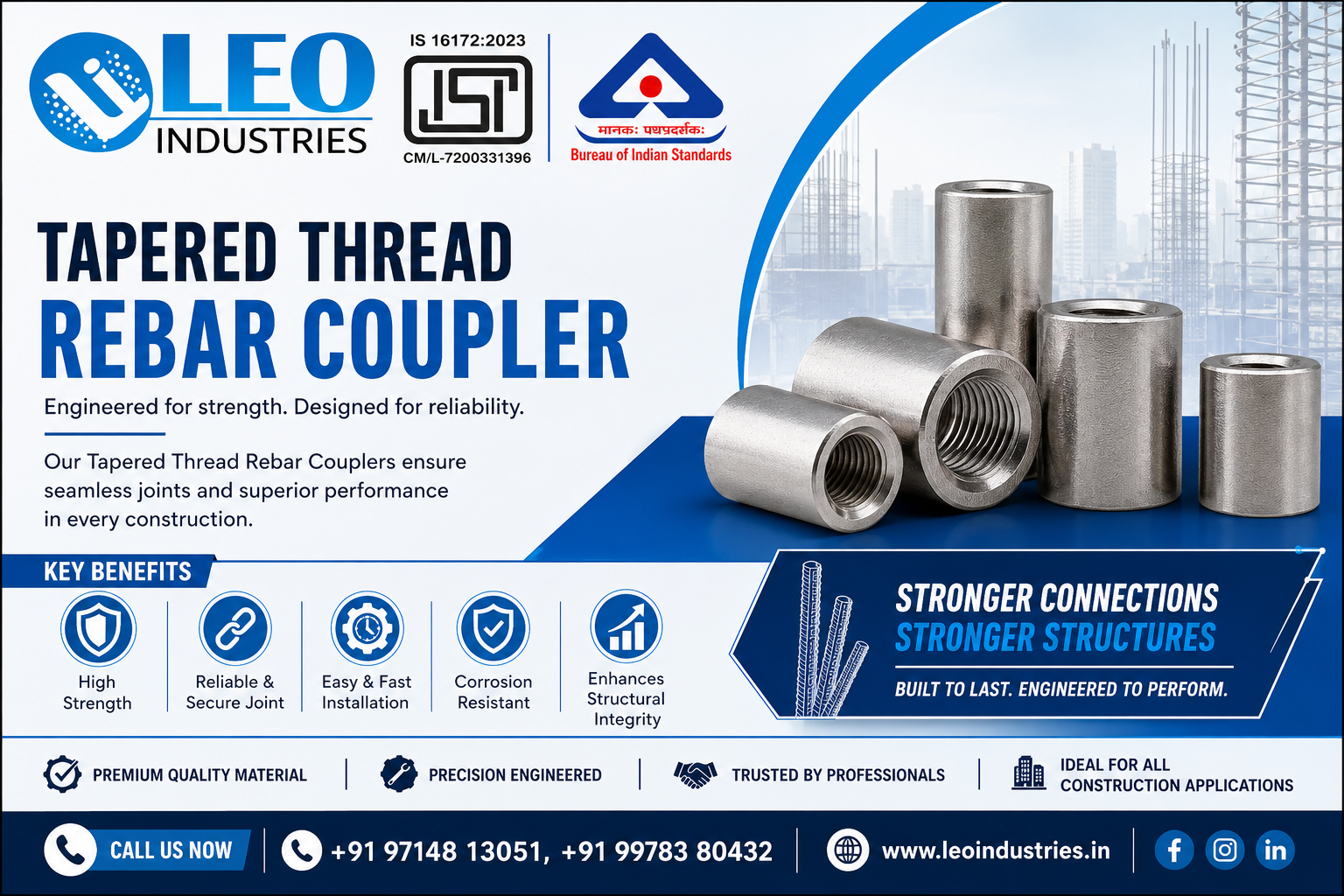
Tapered Thread Rebar Coupler manufacturing company
Precision Mechanical Splicing and Structural Engineering Solutions by Leo Industries
1. Introduction: The Modern Construction Revolution
In the rapidly evolving landscape of global civil engineering, traditional methods of reinforced concrete assembly are undergoing a major transition. Traditional lap splicing, which relies on overlapping bars and steel binding wire, is increasingly viewed as an outdated, material-heavy bottleneck in modern structural design. High-Quality Rebar Couplers represent a highly engineered mechanical alternative that offers a robust structural connection, ensuring monolithic structural continuity. By transmitting tensile and compressive forces directly across a localized joint, couplers remove the risk of bond slippage, which is a common vulnerability under load extremes.
Established as a premier proprietorship firm in the year 2015, Leo Industries has dedicated its engineering expertise to addressing this need from its manufacturing base in Ahmedabad, Gujarat, India. Founded under the guidance and deep industrial knowledge of Mr. Mahesh Patel & Mr. Yagnesh Patel, the team has successfully carved a unique niche in the competitive market. As a leading manufacturer, supplier, and exporter, our objective is to supply mechanical splicing solutions that dramatically increase construction speed, decrease raw material waste, and guarantee compliance with global structural building codes.
2. Deep Dive: Mechanical Splicing Engineering & Threading Technology
The engineering performance of a rebar coupler rests on the absolute precision of its internal threads. At Leo Industries, we utilize cold-forming and precision roll-threading rather than typical material cutting. When structural steel is cut to create threads, the internal grain structure of the metal is broken, which severely compromises the ultimate tensile strength of the splice. In contrast, our roll-threading technology cold-works the steel under immense pressure, forcing the steel grains to conform to the thread profile without cracking or shearing. This increases the hardness and yield strength of the thread zone itself, creating a joint designed to survive dynamic shear stress and cyclic loads.
We process reinforcement bars using diverse threading styles depending on the on-site requirement: parallel threading, tapered threading, and bolt-locking. Tapered thread rebar couplers rely on a decreasing thread diameter that ensures rapid installation and self-centering alignment on site, eliminating cross-threading errors. Parallel threaded couplers offer full mechanical transfer with uniform thread depth, making them ideal for high-tension fatigue zones. For situations where threading on-site is physically impossible, our MBT Rebar Couplers utilize heavy-duty clamping bolts to grip the outer ribs of the rebar directly, providing a high-strength mechanical splice without any specialized bar preparation.
3. Why Choose Mechanical Splicing over Traditional Lapping?
The structural, economic, and operational benefits of adopting rebar couplers over legacy lap splicing are extensive. In standard reinforced concrete structures, lapping requires overlapping reinforcing steel by 40 to 60 times the bar diameter (40D to 60D). This practice translates to massive steel wastage, congested structural joints, and unpredictable load distribution. Because lapped splices depend entirely on the shear strength of the surrounding concrete bond, any local concrete deterioration, thermal cracking, or seismic shifting can cause total structural failure.
Rebar couplers completely bypass these structural limitations by acting as a continuous load path. The benefits include:
- Significant Material Savings: Eliminating overlapping steel can reduce your structural steel consumption by up to 20% to 25%, drastically lowering material purchasing and shipping costs.
- Minimized Steel Congestion: Reducing overlapping steel columns allows high-performance concrete to flow freely through the dense framework. This guarantees uniform concrete density and prevents dangerous structural voids, air pockets, or "honeycombing."
- Monolithic Continuity: A mechanical coupler splice ensures that tension and compression loads are transferred in a straight, uninterrupted line, matching the behavior of a single, continuous steel bar.
- Enhanced Seismic Resistance: Unlike lap joints that degrade under cyclical earthquake forces, high-quality couplers are engineered to survive cyclic load reversals.
4. Industrial Applications & Critical Infrastructure
Due to their reliable load-transfer capabilities, mechanical rebar couplers are widely specified in high-load structural designs. Our couplers serve a diverse range of civil engineering projects where compromise is not an option. This includes high-rise commercial structures, subterranean metro rail systems, elevated expressways, coastal flyovers, and heavy industrial plant foundations. In massive columns, sheer walls, and bridge piers, where high-density steel reinforcement is crucial, our parallel and tapered thread couplers maintain design geometry without causing concrete blockage.
Additionally, we manufacture and supply specialized couplers for highly demanding marine and coastal developments. Waterfront infrastructure, chemical refining plants, and port facilities are constantly exposed to saltwater, moisture, and chemical vapor. For these applications, we utilize corrosion-resistant stainless steel alloys to build durable couplers. Our products protect structural skeletons against accelerated oxidation and rust, ensuring that critical bridges and marine retaining walls remain structurally sound over long design life cycles.
5. Material Engineering & Workshop Capabilities
At Leo Industries, we believe that material selection is the primary foundation of structural safety. We manufacture components using a highly specified list of engineering materials:
- Stainless Steel Grades: SS316, SS316L (low carbon for premium weldability), SS304, SS410, SS420, and high-performance Super Duplex, which offers superior resistance to chloride-induced stress corrosion cracking.
- Mild & Carbon Steel Grades: High-tensile M.S., EN8, EN31, and WPS, selected for their balanced ductility, high shear resistance, and ease of machining.
- Alternative Structural Materials: Aluminum, high-purity Copper, and specialized Nylon, primarily used in non-magnetic structural zones or electrical isolators.
Our modern workshop is equipped with an advanced array of manufacturing machinery to ensure precision machining of these demanding steel alloys. Our machine inventory includes: 01 Computer Numerical Control (CNC) machining center, Lathe machines, Pillar Drill units, Milling machines, Buffing machinery, Horizontal Broaching machines, Bandsaws, Rebar Forging machines, Rebar Threading machines, and Rebar Roll-Threading machines. Given the highly technical multi-operation processes required for sophisticated custom engineering components, we occasionally collaborate with audited, registered external vendors to streamline specific treatment operations (such as high-temperature heat treatments), ensuring seamless, high-volume order fulfillment.
6. Quality Standards & Rigorous Quality Assurance
A structural component is only as reliable as the testing protocols it undergoes. At Leo Industries, quality assurance is an active, multi-stage process integrated into every phase of production. We maintain a sharp focus on the specific structural thresholds required by modern civil codes, ensuring that our couplers consistently perform beyond standard limits. Our quality cycle starts immediately with raw material selection, verifying mill test reports to confirm exact carbon equivalents, alloy concentrations, and base yield strengths before any machining begins.
During and after the cold-forming and threading processes, our dedicated quality control inspectors use precision thread gauges, profile projectors, and digital micrometers to check dimensional accuracy. Every production batch is subjected to destructive tension testing to confirm a "bar-break" failure profile—verifying that the spliced connection can withstand load beyond the yield strength of the rebar. This rigorous quality framework guarantees that our customers receive rebar couplers that perform flawlessly under extreme tensile, compressive, and dynamic structural loading.
7. Why Choose Leo Industries?
Selecting a partner for your structural engineering supply chain is a critical decision. Since our founding in 2015, Leo Industries has earned the trust of developers, structural engineers, and contractors across India and international markets. Our specialized 1,000 square foot facility located in Amraiwadi, Ahmedabad, Gujarat, is optimized for maximum manufacturing efficiency, enabling us to handle complex production demands with absolute precision.
Our core advantages include:
- Founders' Expert Vision: Guided by the combined engineering experience and strategic management of Mr. Mahesh Patel & Mr. Yagnesh Patel.
- Comprehensive Product Line: Providing rebar couplers, tapered thread couplers, parallel threaded couplers, MBT couplers, roll-threading machinery, replacement rollers, and threading blades under one roof.
- Reliable Vendor Network: Collaborating with audited registered vendors to scale manufacturing capacity and handle specialized finishing operations without compromising on timeline or quality.
- On-Time Global Delivery: Supplying cost-effective engineering components globally within strict structural engineering timelines.