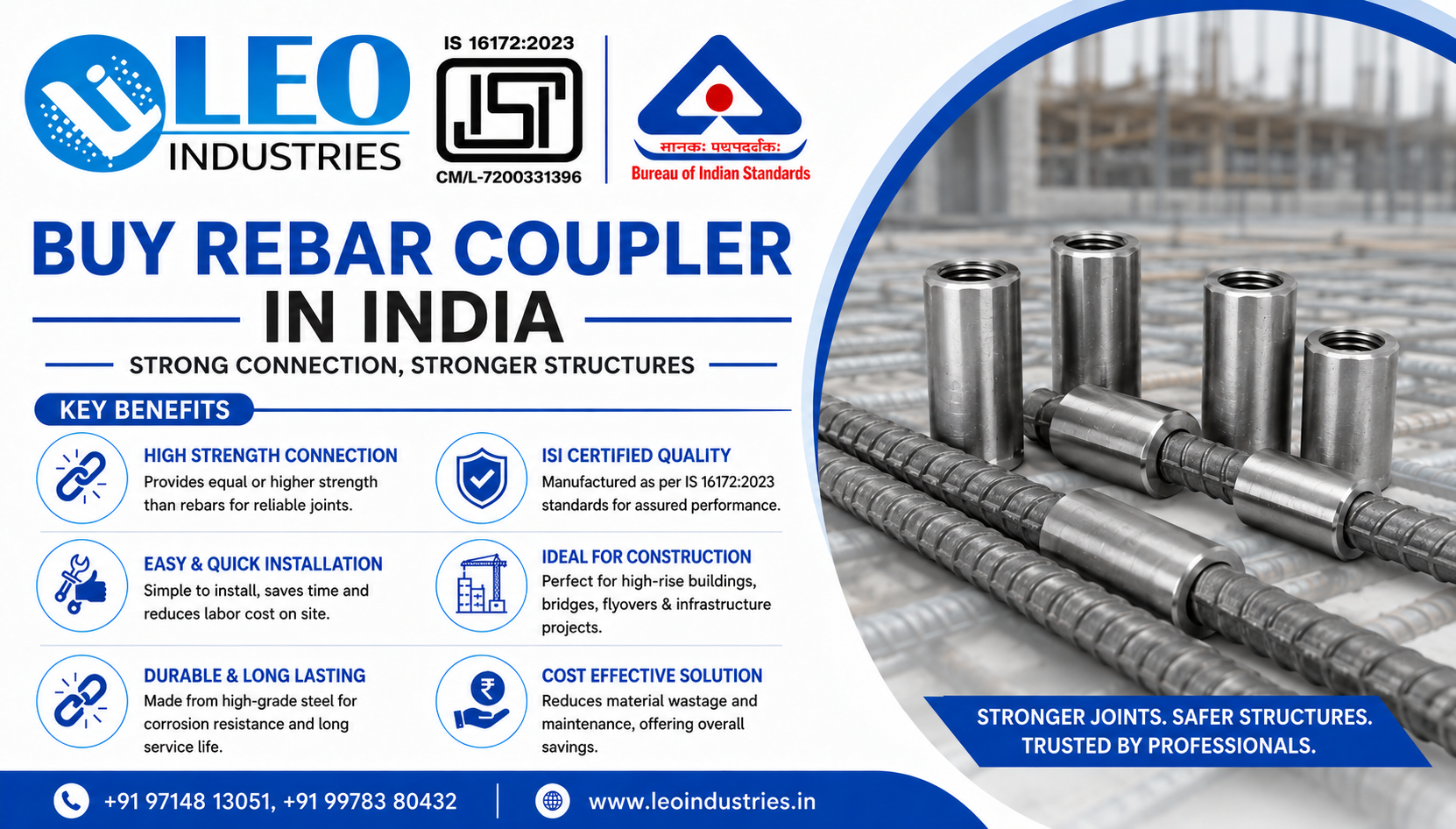
Buy Rebar Coupler in India
Looking to buy rebar coupler in India? Explore durable, high-strength rebar connection solutions from Leo Industries in Ahmedabad for your construction projects
Why This Matters in Ahmedabad and Beyond
Ahmedabad has emerged as a significant hub for industrial and commercial infrastructure development in Gujarat. With rapid urbanization and the expansion of high-rise residential and commercial complexes, the demand for reliable construction materials has reached an all-time high. In a region where seismic considerations and heavy load-bearing requirements are standard, the reliance on traditional lap splicing is increasingly being replaced by mechanical splicing. Mechanical couplers provide a consistent, reliable connection that performs predictably under stress, making them a preferred choice for local developers who prioritize structural longevity and compliance with modern building codes.
What is a Rebar Coupler — Overview
A rebar coupler is a mechanical device used to connect two reinforcing bars, effectively replacing the traditional lap splicing method. By creating a direct, end-to-end connection, couplers ensure that the load is transferred efficiently from one bar to the next. This technology is widely used in bridges, high-rise buildings, dams, and industrial plants. Unlike lap joints, which rely on the bond between concrete and steel, couplers provide a positive mechanical connection that remains effective even if the surrounding concrete cracks or spalls. They are available in various configurations, including tapered thread, parallel thread, and reducer types, each designed for specific structural requirements.
Key Features and Technical Specifications
High tensile strength capable of exceeding the yield strength of the rebar itself.
Precision-engineered threading to ensure a secure, slip-free fit during installation.
Compatibility with various steel grades, including M.S., EN8, EN31, and stainless steel variants like SS316 and SS304.
Compact design that reduces congestion in heavily reinforced concrete sections.
Simplified installation process that does not require specialized skilled labor for every connection.
Corrosion-resistant finishes available for projects in high-moisture or coastal environments.
Industrial Applications and Use Cases
High-rise building construction where vertical reinforcement continuity is critical for load transfer.
Bridge and flyover projects requiring high-performance connections that can withstand dynamic traffic loads.
Infrastructure projects such as tunnels and metro rail systems where space for lap splicing is limited.
Industrial plant foundations and heavy machinery bases that require high-strength, vibration-resistant reinforcement.
Seismic-resistant structures where the ductility and reliability of the reinforcement connection are paramount.
How to Choose the Right Rebar Coupler
Selecting the correct coupler involves more than just matching the bar diameter. A systematic approach ensures that the components will perform as expected under site conditions. Consider the following checklist when evaluating your options:
Verify the load-bearing capacity against the structural design specifications of your project.
Check the material compatibility; ensure the coupler grade matches or exceeds the grade of the TMT bars being used.
Assess the supplier’s manufacturing capability, specifically their ability to maintain tight tolerances during the threading process.
Inquire about the availability of different types, such as reducer couplers for connecting bars of different diameters.
Confirm the availability of technical support and on-site guidance for installation teams.
Review the supplier’s quality control protocols, including their testing procedures for tensile strength and slip.
Quality Standards and Compliance
Structural safety is non-negotiable, and the quality of rebar couplers must align with recognized industrial standards. Buyers should prioritize suppliers who adhere to strict manufacturing protocols, ensuring that every batch meets the necessary tensile and elongation requirements. Verification of material test certificates and adherence to relevant BIS or international standards is a critical step in the procurement process. A reliable manufacturer will maintain rigorous internal testing, including destructive testing on samples, to ensure that the couplers perform consistently under the specified design loads.
Why Company Experience and Capability Matters
The manufacturing of rebar couplers requires a sophisticated blend of engineering expertise and high-precision machinery. At Leo Industries, the foundation of our work is built on years of experience in the engineering sector. Our facility in Ahmedabad is equipped with advanced CNC machines, roll threading technology, and forging equipment, allowing us to maintain precise control over the production cycle. We understand that a coupler is only as good as its thread profile and material integrity. By managing our production in-house and maintaining a team of skilled professionals, we ensure that every component delivered meets the rigorous demands of modern construction sites.
Installation, Maintenance and Care Tips
Proper installation is the final step in ensuring the performance of your reinforcement system. While couplers are designed for ease of use, following best practices is essential for optimal results.
Ensure that the rebar ends are cut square and are free from debris or rust before threading.
Use the correct threading equipment to achieve a clean, uniform thread profile that matches the coupler’s internal dimensions.
Tighten the coupler to the specified torque to ensure a solid, metal-to-metal contact.
For long-term storage, keep couplers in a dry, covered area to prevent surface oxidation before they are installed in the concrete.
Conduct periodic inspections during the assembly phase to ensure that no threads are damaged during handling.
Frequently Asked Questions
Mechanical couplers offer a more reliable and predictable load transfer compared to lap joints, which rely heavily on the concrete bond. By using couplers, you significantly reduce steel congestion, allowing for better concrete flow and vibration. Furthermore, couplers provide superior performance in seismic zones and are essential for projects where structural continuity must be maintained without relying on the surrounding concrete for load transfer.
Yes, rebar reducer couplers are specifically designed for this purpose. These components allow for a seamless transition between two bars of different sizes, which is common in columns where the reinforcement diameter decreases as the building height increases. Using a reducer coupler ensures that the structural integrity is maintained at the transition point without the need for complex, space-consuming lap arrangements.
High-strength couplers are typically manufactured from carbon steel or alloy steel grades such as EN8 or EN31 to ensure they meet the required tensile strength. For specialized applications, such as those in chemical plants or coastal areas, stainless steel grades like SS316 or SS304 are used to provide excellent corrosion resistance. The choice of material depends on the environmental conditions and the specific load requirements of the structure.
To ensure safety, always request material test certificates and proof of tensile testing from your supplier. A reputable manufacturer will provide documentation showing that the couplers have been tested to withstand loads exceeding the yield strength of the rebar. It is also advisable to verify that the supplier follows a documented quality management system, which ensures consistency across every batch of components produced.
The installation process is relatively straightforward and generally requires standard tools such as pipe wrenches or torque wrenches to ensure the couplers are tightened to the correct specification. While the preparation of the rebar ends—such as threading or forging—requires specialized machinery like roll threading machines, the actual assembly of the coupler onto the bar can be performed by trained site personnel without complex equipment.
Sourcing from a local manufacturer in a hub like Ahmedabad provides significant logistical advantages, including faster delivery times and easier access to technical support. Being closer to the manufacturer allows for better communication regarding customization needs and reduces the risks associated with long-distance transport. Furthermore, local suppliers are often more familiar with the specific regional construction challenges and can provide tailored advice based on local project requirements.
Conclusion
Choosing the right rebar connection system is a foundational decision that impacts the safety and durability of any structure. By opting for high-quality mechanical couplers, you ensure that your reinforcement system is robust, efficient, and compliant with modern engineering standards. Whether you are working on a large-scale infrastructure project or a commercial development, focusing on material quality, manufacturing precision, and supplier reliability will yield the best results. At Leo Industries, we remain committed to providing the technical expertise and high-performance components necessary to support the evolving needs of the construction industry in India.
Get In Touch
Leo Industries