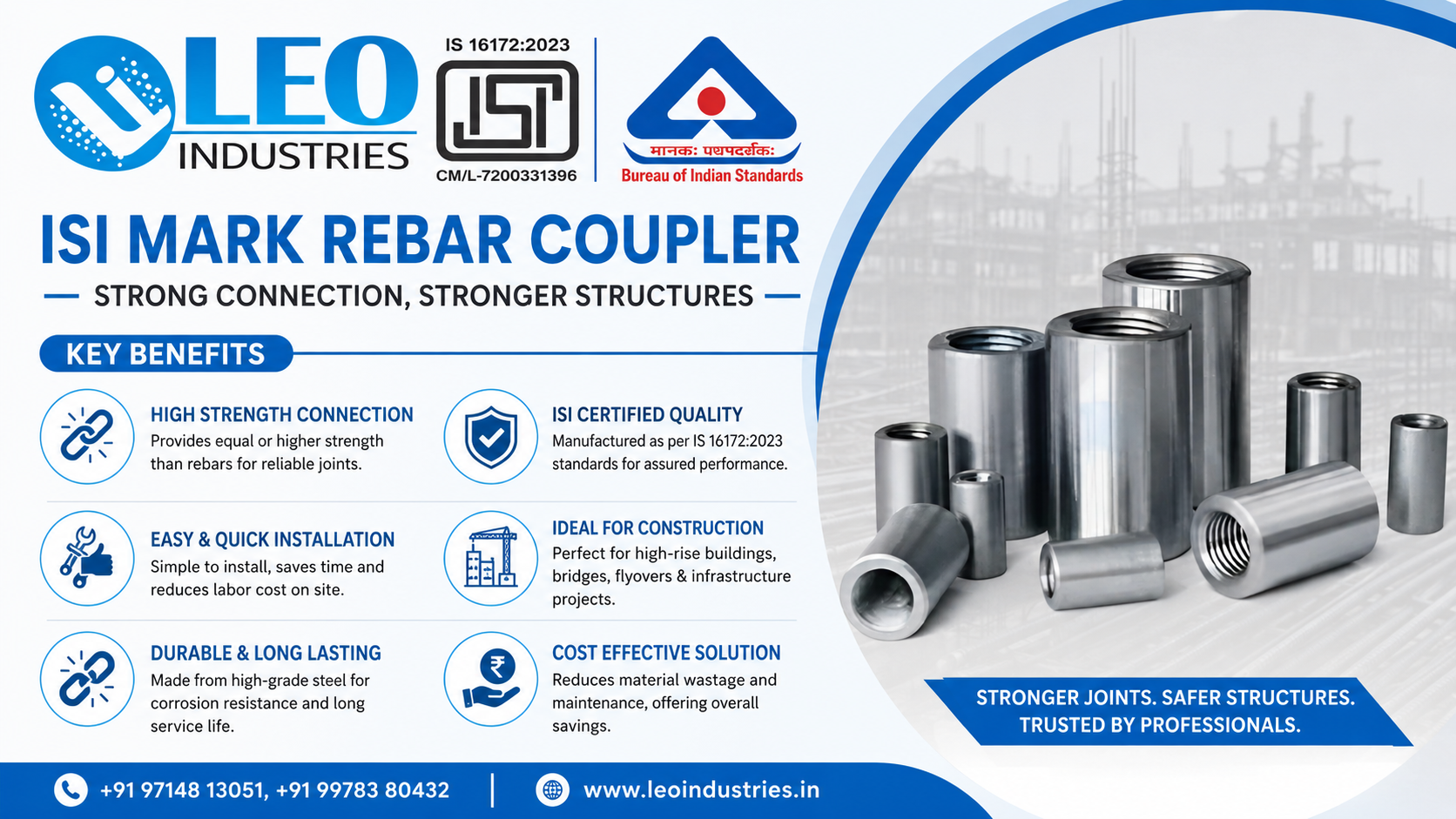
Rebar Coupler for Construction
Understand rebar couplers for construction projects in Ahmedabad. Learn about types, applications, and choosing reliable suppliers for structural integrity.
Why This Matters in Ahmedabad, Gujarat
Ahmedabad, as a rapidly developing urban and industrial hub in Gujarat, is experiencing significant growth in infrastructure, commercial, and residential construction. Projects range from high-rise buildings and flyovers to industrial complexes and metro rail expansions. In such a dynamic environment, where seismic considerations and stringent quality demands are paramount, the reliability and efficiency of rebar connections directly impact project success and long-term safety. Utilizing advanced rebar coupling technology helps meet these demanding local construction requirements.
What Is Rebar Coupler for Construction — Overview
A rebar coupler is a mechanical device designed to connect two reinforcing steel bars (rebars) end-to-end, creating a continuous load path. Unlike traditional lapping, which relies on the bond between concrete and overlapping rebar sections, couplers provide a full-strength mechanical splice. This method ensures that the connection is stronger than the rebar itself, transferring tensile and compressive forces efficiently. Rebar couplers are typically manufactured from high-grade steel and come in various designs, including tapered thread, parallel thread, and grout-filled sleeves, each suited for specific applications and installation methods.
Key Features and Technical Specifications
- Full Strength Connection: Designed to exceed the yield strength of the rebar, ensuring structural continuity.
- Material Compatibility: Manufactured to connect various rebar grades, including Fe500, Fe550, and TMT bars.
- Diverse Threading Options: Available in tapered thread for quick engagement or parallel thread for precise alignment.
- Corrosion Resistance: Options for coatings or stainless steel grades (SS304, SS316) for enhanced durability in harsh environments.
- Reduced Congestion: Eliminates the need for extensive rebar overlap, minimizing steel congestion in concrete.
- Simplified Installation: Engineered for straightforward and reliable assembly on-site, often requiring minimal specialized tools.
- Diameter Versatility: Compatible with a wide range of rebar diameters, from smaller bars to large structural elements.
- Compliance with Standards: Designed and tested to meet relevant national and international construction standards.
Industrial Applications and Use Cases
- High-Rise Buildings: Facilitates efficient rebar connections in columns, beams, and shear walls, especially in congested areas.
- Bridges and Flyovers: Ensures robust and continuous reinforcement for long-span structures and critical load-bearing elements.
- Power Plants and Industrial Structures: Provides durable connections in heavy-duty concrete foundations and structural frameworks.
- Metro Rail and Transportation Infrastructure: Used in tunnels, elevated tracks, and station construction for reliable reinforcement.
- Precast Concrete Elements: Allows for easy and strong connection of pre-manufactured concrete components on-site.
- Seismic Zone Construction: Offers enhanced ductility and structural integrity, crucial for structures in earthquake-prone regions.
- Renovation and Retrofitting Projects: Enables seamless extension or repair of existing reinforced concrete structures.
- Foundation and Piling Work: Connects rebar cages in deep foundations, ensuring continuity and load transfer.
How to Choose the Right Rebar Coupler
Selecting the appropriate rebar coupler is a critical decision that impacts project safety, cost, and timeline. Buyers should consider several factors beyond initial purchase price.
- Rebar Diameter and Grade Compatibility: Ensure the coupler is specifically designed for the exact rebar size and steel grade used in your project.
- Project Specific Load Requirements: Verify that the coupler's strength and performance characteristics meet or exceed the structural design loads.
- Installation Environment and Site Conditions: Consider factors like space constraints, weather exposure, and the availability of skilled labor for installation.
- Manufacturer's Certifications and Quality Control: Look for suppliers who adhere to recognized quality standards and provide verifiable product certifications.
- Technical Support and Customization Options: Assess the supplier's ability to provide technical guidance, custom solutions, or specialized couplers for unique project needs.
- Delivery Logistics and Lead Times: Confirm that the supplier can reliably deliver the required quantities within your project schedule.
- After-Sales Service and Training: Evaluate the availability of support for installation queries or any post-delivery assistance.
Quality Standards and Compliance
The integrity of rebar couplers is paramount for structural safety. Buyers must ensure that the products comply with relevant national and international standards. In India, standards like IS 16172 (for mechanical splices of reinforcing bars) are crucial. International standards such as ISO and ASTM also provide benchmarks for material quality, manufacturing processes, and performance testing. Verifying a supplier's adherence to these standards, including material traceability, manufacturing process controls, and independent third-party testing, is essential. This due diligence ensures that the rebar couplers will perform as expected under design loads and environmental conditions.
Why Leo Industries Experience and Capability Matters
Leo Industries, established in Ahmedabad, Gujarat in 2015, brings a focused approach to manufacturing engineering products, including a range of rebar couplers. Our founders, Mr. Mahesh Patel and Mr. Yagnesh Patel, guide the team with their extensive experience and knowledge in this specialized field. We utilize a well-equipped workshop with CNC machines, rebar forging machines, and rebar threading and roll-thread machines, allowing for precise manufacturing. Our capability extends to working with various materials, including stainless steel grades like SS316, SS304, and SS420, as well as mild steel grades such as M.S., EN8, and EN31. This diverse material expertise and in-house machining capacity enable us to produce rebar couplers that meet specific project requirements and maintain consistent quality. We prioritize stringent checking at all levels, from material sourcing to final product delivery, to ensure the reliability of our components.
Installation, Maintenance and Care Tips
Proper installation is crucial for the effective performance of rebar couplers. Ensure that rebar ends are cut squarely and free from burrs or deformations before threading. The threading process itself must be precise, matching the coupler's specifications. During assembly, apply the correct torque as recommended by the manufacturer to achieve a secure and full-strength connection. Visual inspection after installation is important to confirm proper engagement and alignment.
Once installed, rebar couplers generally require minimal maintenance as they are encased in concrete. However, during storage and before installation, protect couplers from moisture, dirt, and corrosive elements to prevent damage or contamination that could compromise their performance. Store them in a dry, covered area, away from direct sunlight and extreme temperatures.
Frequently Asked Questions
Rebar couplers provide a full-strength mechanical splice, ensuring the connection is stronger than the rebar itself, unlike lapping which relies on concrete bond. This method reduces rebar congestion, minimizes material waste, and offers more predictable structural performance, especially in high-stress areas or seismic zones.
Yes, rebar couplers are designed to accommodate a wide range of rebar diameters. Manufacturers typically offer couplers for standard rebar sizes, and specialized or reducer couplers are available for connecting bars of different diameters. It is crucial to select a coupler that precisely matches the rebar dimensions specified for the project.
Rebar couplers are commonly manufactured from high-grade carbon steel or alloy steel to match the strength properties of reinforcing bars. For projects requiring enhanced corrosion resistance, such as those in marine environments or exposed conditions, couplers made from stainless steel grades like SS304 or SS316 are also available.
Proper installation involves several steps: ensuring rebar ends are cut square and clean, accurately threading the rebar to match the coupler, and applying the correct torque during assembly. Following the manufacturer's specific installation guidelines and utilizing trained personnel are essential for achieving a secure and reliable connection.
When correctly specified and installed, rebar couplers enhance the structural integrity of concrete by providing a continuous, full-strength load path for the reinforcing steel. They eliminate the weak points often associated with traditional rebar lapping, contributing to a more robust and predictable structural system, particularly under dynamic or seismic loads.
When selecting a supplier, look for certifications that demonstrate adherence to quality and performance standards. This includes compliance with relevant national standards like IS 16172 in India, as well as international standards such as ISO 9001 for quality management. Verifiable product test reports and material traceability are also important indicators of reliability.
Conclusion
The effective use of rebar couplers is a cornerstone of modern, resilient construction, particularly in a growing region like Ahmedabad, Gujarat. These mechanical splicing solutions offer significant advantages in terms of structural strength, material efficiency, and construction speed compared to traditional methods. Making an informed choice involves understanding the technical specifications, verifying compliance with quality standards, and partnering with a manufacturer that demonstrates proven experience and capability. Focusing on these factors ensures that your construction projects are built on a foundation of reliability and long-term performance.
Get In Touch
Leo Industries