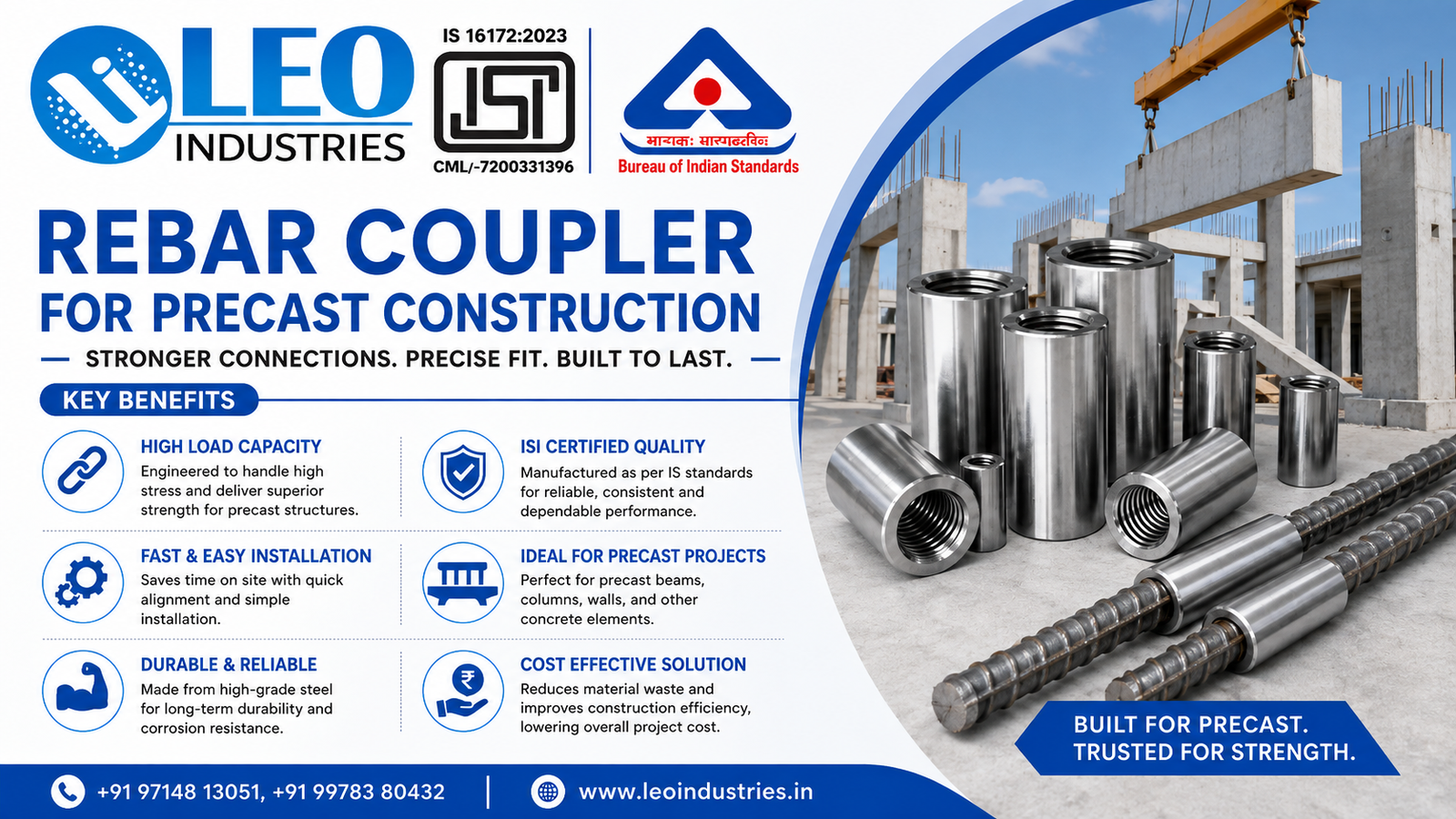
Rebar Coupler for Precast Construction
Discover how Leo Industries in Ahmedabad provides high-quality rebar couplers for precast construction, ensuring structural integrity and efficient project time
Key Features and Technical Specifications
When selecting rebar couplers for precast applications, several technical aspects are crucial for ensuring optimal performance and structural integrity. These couplers are designed with precision to meet stringent engineering requirements.
- Material Strength: Typically manufactured from high-grade steel (like carbon steel or stainless steel) to match or exceed the tensile strength of the rebars being joined.
- Thread Type: Available in parallel thread, tapered thread, or other specialized thread forms to ensure a secure and strong mechanical interlock.
- Corrosion Resistance: Options for galvanized or stainless steel variants are available for environments requiring enhanced protection against rust and degradation.
- Ease of Installation: Designed for quick and straightforward installation, often requiring only a wrench, which speeds up precast element production.
- Load Transfer Capability: Engineered to efficiently transfer axial loads (tension and compression) between rebars without slippage.
- Bar Diameter Compatibility: Available in a range of sizes to accommodate various rebar diameters commonly used in construction.
- Durability: Built to withstand the stresses and strains of construction and the operational life of the structure.
Industrial Applications and Use Cases in Precast Construction
The versatility and reliability of rebar couplers make them indispensable in a wide array of precast construction applications. Their use significantly enhances construction speed and structural integrity.
- Precast Beam and Column Connections: Joining rebars in precast beams and columns to create continuous structural frames for buildings.
- Precast Slab Reinforcement: Connecting rebars in precast slabs, especially for large span applications or where continuous reinforcement is critical.
- Bridge Deck Construction: Used in precast bridge segments to ensure robust reinforcement continuity across deck joints.
- Precast Wall Panels: Facilitating the connection of reinforcement in precast wall elements for residential, commercial, and industrial buildings.
- Tunnel Segments: Employed in the manufacturing of precast tunnel lining segments, ensuring structural integrity under immense pressure.
- Precast Foundation Elements: Connecting rebars in precast foundation components for enhanced load-bearing capacity.
- Modular Construction: Integral to modular building systems where precast components are assembled on-site.
How to Choose the Right Rebar Coupler for Your Project
Selecting the appropriate rebar coupler is a critical decision that impacts the safety, durability, and efficiency of your precast construction project. Consider these factors carefully.
- Rebar Diameter and Grade: Ensure the coupler is designed for the specific diameter and grade of the rebars you are using.
- Required Tensile Strength: Verify that the coupler's mechanical properties meet or exceed the design requirements for load transfer.
- Environmental Conditions: Consider the need for corrosion resistance based on the project's location and exposure to moisture or aggressive chemicals.
- Type of Connection: Determine if a parallel, tapered, or other specialized thread type is most suitable for your application.
- Certifications and Standards: Look for couplers that comply with relevant national and international construction standards (e.g., ISO, BIS).
- Supplier Reputation and Experience: Choose a manufacturer with a proven track record in producing reliable rebar couplers.
- Ease of Installation: Assess the installation requirements to ensure your construction team can efficiently implement them on-site or in the precast yard.
- After-Sales Support: Inquire about technical assistance and support provided by the supplier.
Quality Standards and Compliance
For any structural component, adherence to quality standards and compliance with regulations is paramount. Rebar couplers are no exception. Reputable manufacturers ensure their products meet rigorous testing and certification requirements. In India, standards like IS 1608 (Mechanical Testing of Metals) and relevant BIS specifications for reinforcing steel are often referenced. Manufacturers should be able to provide documentation demonstrating compliance, such as test reports for tensile strength, yield strength, and elongation.
For precast construction, consistency in quality is vital. Couplers must perform reliably under various load conditions. Choosing a supplier that adheres to ISO 9001 quality management systems indicates a commitment to consistent product quality and manufacturing processes. Buyers should always verify the certifications and compliance documentation provided by the manufacturer to ensure the couplers meet the project's specific engineering and safety demands.
Why Leo Industries' Experience and Capability Matter
Established in 2015 in Ahmedabad, Gujarat, Leo Industries has built a solid reputation as a manufacturer and supplier of high-quality rebar couplers. Our experience in engineering products, particularly in the realm of steel and reinforcement solutions, allows us to understand the precise needs of the construction industry. We leverage advanced manufacturing capabilities, including CNC machines and specialized rebar threading and rolling machines, to produce couplers that meet exacting standards.
Our team possesses deep technical expertise, enabling us to work with a variety of materials, including different grades of stainless steel and mild steel, as well as other alloys. This capability ensures we can offer solutions tailored to diverse project requirements, from standard applications to those demanding enhanced corrosion resistance. We are committed to stringent quality control at every stage of production, from material sourcing to final inspection. This dedication, combined with our focus on reliable delivery and customer support, makes Leo Industries a trusted partner for your precast construction needs in Ahmedabad and beyond.
Installation, Maintenance, and Care Tips
Proper installation and care of rebar couplers are essential for ensuring their long-term performance and the integrity of the structure.
- Cleanliness: Ensure both the rebar threads and the coupler threads are clean and free from dirt, debris, or any foreign matter before installation.
- Thread Engagement: Screw the coupler onto the rebar thread for its full length to achieve maximum engagement.
- Tightening: Use appropriate torque wrenches or standard wrenches to tighten the coupler securely, following manufacturer guidelines. Avoid over-tightening, which can damage threads.
- Inspection: Visually inspect each connection after installation to ensure it is properly seated and tightened.
- Storage: Store couplers in a dry, protected environment to prevent corrosion or damage before use.
- Material Compatibility: Always use couplers designed for the specific diameter and type of rebar.
Frequently Asked Questions
The primary function of a rebar coupler in precast construction is to mechanically join two reinforcing bars end-to-end. This allows for continuous reinforcement across joints in precast elements, ensuring that tensile and compressive forces are effectively transferred, thereby creating a monolithic and structurally sound component.
Rebar couplers offer several advantages over traditional lapping. They eliminate the need for extensive overlapping, which saves space and material. Couplers provide a more predictable and consistent connection strength, are generally faster to install, and are less susceptible to construction complexities like congestion.
Rebar couplers are typically manufactured from high-strength steel. This includes various grades of carbon steel for general applications and stainless steel (such as SS304, SS316) for environments requiring enhanced corrosion resistance. Other materials like aluminum or specialized alloys may be used for specific applications.
Yes, many types of rebar couplers are designed and tested to perform exceptionally well under seismic loads. Their mechanical connection provides a robust and reliable splice that can withstand significant dynamic forces, making them suitable for earthquake-resistant structures.
When properly selected, installed, and protected from extreme corrosive environments, rebar couplers are designed to last for the entire service life of the structure. Their lifespan is generally equivalent to that of the reinforcing steel bars they connect, often many decades.
To ensure quality, always purchase from reputable manufacturers like Leo Industries who adhere to strict quality control measures and international standards. Request documentation such as material test certificates, compliance reports, and evidence of third-party testing to verify their performance characteristics.
Conclusion
For precast construction projects in Ahmedabad and across Gujarat, the selection of high-quality rebar couplers is a non-negotiable aspect of ensuring structural integrity and project success. These mechanical connectors are vital for achieving the speed, efficiency, and strength that precast technology promises. By understanding the technical specifications, application suitability, and the importance of choosing an experienced and reliable supplier like Leo Industries, you can confidently specify and implement rebar couplers that meet the demanding requirements of modern construction.
Get In Touch
Leo Industries