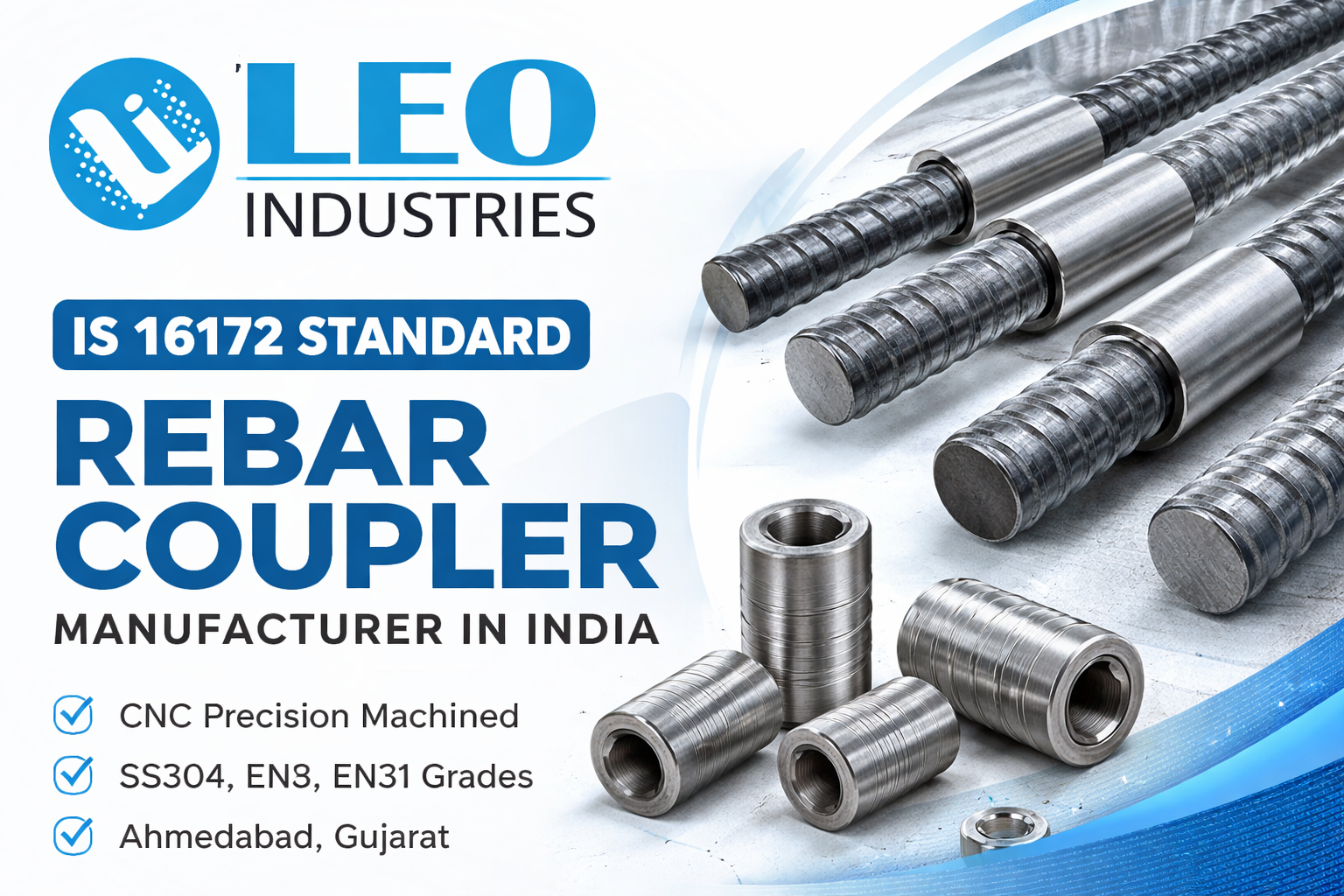
IS 16172 Standard Rebar Coupler
Manufacturer in India
In modern construction, structural integrity depends heavily on how reinforcement bars are connected. Traditional lap splicing methods are gradually being replaced by advanced mechanical solutions that offer higher strength, consistency, and efficiency. One such widely adopted solution is the IS 16172 standard rebar coupler in India, designed to meet strict quality and safety requirements in reinforced concrete structures.
Leo Industries — Rebar Coupler Manufacturer, Ahmedabad
Leo Industries, based in Ahmedabad, Gujarat, has been manufacturing a range of rebar couplers and engineering components since 2015. With a well-equipped infrastructure and a strong focus on precision machining, the company produces components using materials such as stainless steel, mild steel, and specialized alloys. Their operational capabilities include CNC machining, threading, forging, and finishing processes, ensuring consistent and reliable product output.
Understanding IS 16172 Standard in Rebar Couplers
The IS 16172 standard defines the requirements for mechanical splicing of reinforcing bars in India. It ensures that couplers provide reliable load transfer between rebars without compromising structural safety. This standard plays a critical role in large-scale infrastructure, high-rise buildings, bridges, and industrial construction where performance and consistency are essential.
An IS 16172 standard rebar coupler is designed to deliver tensile strength equal to or greater than the parent bar. This eliminates weak points within the structure and enhances overall durability. The standard also includes testing procedures, dimensional accuracy, and performance criteria, making it a trusted guideline for engineers and contractors.
Role of Rebar Couplers in Modern Construction
Rebar couplers have significantly improved reinforcement practices by replacing traditional overlapping techniques. In high-density reinforcement areas, lap splicing often leads to congestion and challenges in concrete placement. Mechanical couplers provide a more efficient and practical solution.
These couplers create a direct bar-to-bar connection, ensuring uniform load distribution throughout the structure. They also help reduce steel consumption, streamline construction timelines, and improve site safety. Their application is particularly beneficial in projects where space constraints and structural precision are important.
Types of Rebar Couplers Used in Construction
Rebar couplers are available in different designs based on project requirements and connection types. Each type serves a specific function in structural applications.
- 01 Parallel Threaded Couplers — Commonly used to join bars of the same diameter. These couplers require threading on both ends and provide a strong mechanical connection.
- 02 Tapered Thread Couplers — Suitable for projects where quick installation and alignment are required. They offer ease of assembly while maintaining structural strength.
- 03 Reducer Couplers — Used when connecting rebars of different diameters. They are especially useful in structural transitions where load distribution must be managed effectively.
- 04 Stainless Steel Couplers — Applied in environments where corrosion resistance is necessary, such as marine or chemically exposed structures.
Applications of IS 16172 Rebar Couplers in India
Rebar couplers compliant with IS 16172 are widely used across various construction segments due to their reliability and performance.
- High-rise residential and commercial buildings
- Infrastructure projects such as bridges and flyovers
- Industrial plants and heavy engineering structures
- Metro rail and transportation projects
- Water treatment and marine structures
These applications require consistent load transfer, structural safety, and long-term durability, all of which are supported by standardized coupler solutions.
Advantages of Using IS 16172 Standard Rebar Couplers
Mechanical couplers offer several practical benefits that improve construction efficiency and structural performance.
- Ensures full strength continuity of reinforcement bars
- Reduces steel wastage compared to lap splicing
- Minimizes congestion in heavily reinforced areas
- Improves construction speed and overall productivity
- Provides reliable performance under dynamic loads
- Supports better quality control and inspection
These advantages make rebar couplers a preferred choice in modern engineering practices, particularly in projects with strict quality requirements.
Importance of Ahmedabad as a Manufacturing Hub
Ahmedabad, Gujarat, has emerged as a key center for engineering and manufacturing industries in India. The region offers access to skilled labor, raw materials, and well-developed industrial infrastructure, making it a suitable location for production facilities.
Companies operating in Ahmedabad benefit from strong supply chain networks and connectivity to major construction markets across the country. This enables manufacturers like Leo Industries to serve a wide client base efficiently while maintaining consistent production standards.
The presence of industrial estates and supporting industries further strengthens the ecosystem for engineering component manufacturing.
Quality Considerations in Rebar Coupler Selection
Selecting the right rebar coupler is essential for ensuring structural safety and long-term performance. Engineers and contractors must evaluate several factors before making a decision.
Material quality plays a critical role in strength and durability. Couplers made from certified steel grades ensure reliable performance under load.
Dimensional accuracy is important for proper fitment and alignment. Precision machining helps prevent installation issues and ensures effective load transfer.
Compliance with standards such as IS 16172 ensures that the product has undergone necessary testing and meets defined performance criteria.
Installation method and ease of use also influence project timelines. Couplers designed for efficient assembly can improve on-site productivity.
Inspection and testing capabilities should be considered to verify performance during and after installation.
Future of Rebar Coupler Technology in India
With increasing demand for high-rise buildings and infrastructure development, the adoption of mechanical splicing solutions is expected to grow steadily. Rebar couplers are becoming a standard practice in construction due to their efficiency and reliability.
Advancements in manufacturing technology, material science, and quality control processes are further enhancing the performance of these components. The focus is gradually shifting toward sustainable construction practices, where optimized material usage and reduced waste play a significant role.
Manufacturers are also adopting automation and precision engineering techniques to improve consistency and scalability. As construction standards continue to evolve, the role of IS-compliant rebar couplers will expand across multiple sectors.
Frequently Asked Questions
Conclusion
The use of IS 16172 standard rebar coupler in India has become an essential part of modern construction practices. These couplers provide reliable mechanical connections that enhance structural integrity, reduce material usage, and improve overall project efficiency.
With manufacturing capabilities supported by advanced machinery and material expertise, companies like Leo Industries contribute to the growing demand for high-quality rebar coupling solutions. As infrastructure development continues to expand across India, standardized and precision-engineered components will play a key role in building safe and durable structures.