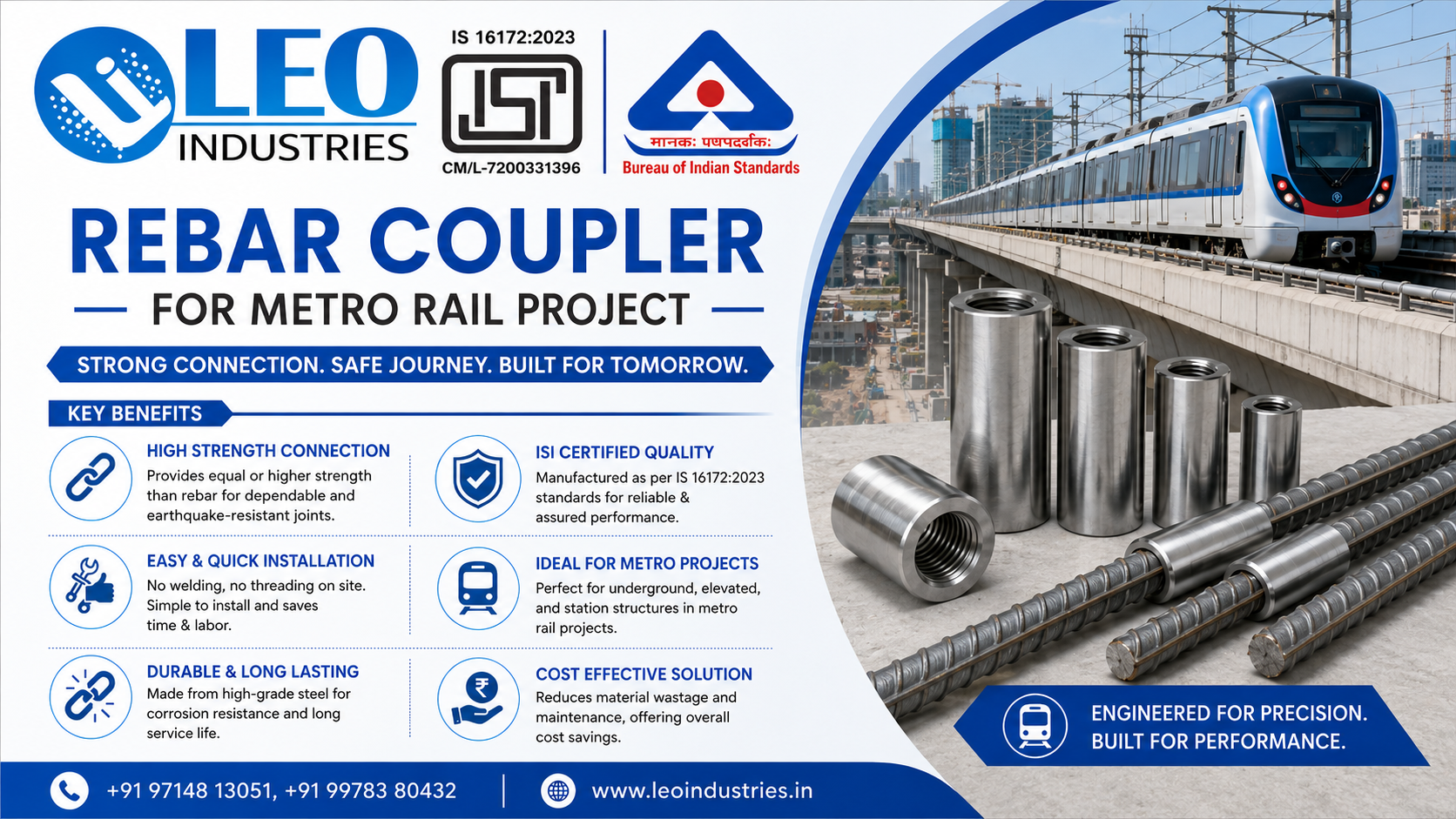
Rebar Coupler for Metro Rail Project
Essential rebar couplers for Ahmedabad's metro rail projects. Learn about types, applications, and quality standards from Leo Industries.
What is a Rebar Coupler? An Overview
A rebar coupler, also known as a rebar splice or mechanical splice, is a device used to join two reinforcing steel bars (rebars) end-to-end. Unlike traditional lap splicing, which relies on overlapping bars and concrete bonding, couplers create a direct mechanical connection. This connection is typically achieved through threading, swaging, or bolting mechanisms that effectively transfer tensile and compressive forces between the rebars. They are engineered to provide a connection strength equal to or greater than that of the rebar itself, ensuring a seamless load transfer within the concrete structure.
Key Features and Technical Specifications
When selecting rebar couplers for demanding applications like metro rail projects, specific features and adherence to technical standards are non-negotiable. The following are critical considerations:
- High Tensile Strength: Couplers must be designed to withstand loads exceeding the yield strength of the rebar they connect, ensuring structural integrity under stress.
- Corrosion Resistance: Materials and coatings are vital to prevent rust and degradation, especially in environments exposed to moisture or aggressive soil conditions common in urban construction.
- Ease of Installation: Efficient installation procedures reduce labor time and potential for error on-site, crucial for project timelines.
- Versatility: Ability to connect rebars of varying diameters and types (e.g., TMT bars) is essential for diverse project needs.
- Thread Type: Options include parallel threads, tapered threads, and other specialized designs, each offering specific advantages in grip and load transfer.
- Material Quality: Couplers are typically manufactured from high-grade steel (e.g., carbon steel, stainless steel) to ensure durability and performance.
- Compliance with Standards: Adherence to national and international standards (e.g., ISO, ASTM, IS) is a primary indicator of quality and reliability.
Industrial Applications and Use Cases
The robustness and reliability of rebar couplers make them indispensable across various demanding construction sectors, particularly for large-scale infrastructure projects.
- High-Rise Buildings: Ensuring structural integrity and efficient reinforcement placement in tall buildings.
- Bridges and Flyovers: Providing strong, continuous reinforcement for load-bearing elements subjected to heavy traffic.
- Tunnels and Underground Structures: Facilitating reinforcement in confined spaces and ensuring structural stability against earth pressure.
- Dams and Water Retaining Structures: Offering leak-proof and high-strength connections essential for water containment.
- Industrial Foundations: Supporting heavy machinery and industrial loads with reliable rebar connections.
- Seismic Zone Construction: Providing enhanced ductility and load transfer capabilities crucial for earthquake-prone regions.
- Precast Concrete Elements: Enabling efficient assembly and connection of precast components on-site.
How to Choose the Right Rebar Coupler
Selecting the appropriate rebar coupler is a critical decision that impacts the safety, longevity, and cost-effectiveness of a construction project. Consider these factors:
- Rebar Diameter and Grade: Ensure the coupler is designed for the specific diameter and grade of rebar being used.
- Load Requirements: Assess the tensile and compressive forces the connection will need to withstand based on structural design.
- Environmental Conditions: Consider factors like moisture, soil acidity, and potential for corrosion when choosing materials and coatings.
- Installation Method: Evaluate the ease and speed of installation, as well as the specialized tools or training required.
- Project Specifications and Standards: Verify that the chosen coupler meets all project-specific requirements and relevant industry standards (e.g., IS 13920 for seismic design).
- Supplier Reputation and Experience: Choose a manufacturer with a proven track record in producing high-quality, reliable rebar couplers.
- Testing and Certification: Request documentation of third-party testing and certifications to confirm performance claims.
- Cost-Effectiveness: Balance the initial cost with long-term performance, durability, and potential savings in labor and material.
Quality Standards and Compliance
For critical infrastructure like metro rail projects in Ahmedabad, adherence to stringent quality standards and compliance with relevant regulations is paramount. Manufacturers must demonstrate that their rebar couplers meet or exceed national and international benchmarks. This often includes compliance with Indian Standards (IS) such as IS 13920 (Ductile Design and Detailing of Reinforced Concrete Structures Subjected to Seismic Forces) and IS 1608 (Mechanical Testing of Steel Products). International standards like ASTM A615/A615M for deformed and plain carbon-steel bars for concrete reinforcement, and ISO standards for quality management systems, also play a significant role. Buyers should always verify that the couplers are accompanied by test certificates and documentation confirming their compliance with specified standards, ensuring they are fit for purpose.
Why Leo Industries' Experience and Capability Matters
Established in 2015 in Ahmedabad, Gujarat, Leo Industries has built a strong foundation in manufacturing and supplying high-quality rebar couplers. Our experience is rooted in understanding the specific demands of infrastructure projects, including those for metro rail development. We leverage advanced manufacturing processes, utilizing machinery like CNC lathes and specialized rebar threading machines, to produce couplers with precision. Our team possesses deep expertise in metallurgy and mechanical engineering, allowing us to work with a wide range of materials, from standard mild steel to specialized stainless steel grades like SS316 and SS316L, ensuring optimal performance and corrosion resistance.
Our commitment to quality control is rigorous, with checks implemented at every stage of production. We understand that reliability is key for metro projects, and our manufacturing capabilities are geared towards delivering consistent, high-performance products. Furthermore, our ability to offer customized solutions and our focus on dependable delivery make us a trusted partner for construction companies undertaking complex infrastructure challenges in Ahmedabad and across India.
Installation, Maintenance, and Care Tips
Proper installation and care are vital to ensure the long-term performance of rebar couplers.
- Cleanliness: Ensure the threads of both the rebar and the coupler are clean and free from dirt, debris, or damage before assembly.
- Thread Engagement: For threaded couplers, ensure the rebar is fully engaged into the coupler, screwing it in until it bottoms out or reaches the specified torque.
- Torque Specifications: If specified, use calibrated torque wrenches to tighten the coupler to the manufacturer's recommended settings.
- Inspection: Visually inspect each connection after installation to confirm proper seating and absence of any visible defects.
- Protection: Where necessary, apply protective coatings or sealants to the assembled coupler to guard against environmental factors, especially in corrosive conditions.
- Storage: Store couplers in a dry, protected area to prevent rust and damage to threads before installation.
Frequently Asked Questions
In metro rail construction, rebar couplers serve to mechanically join reinforcing steel bars end-to-end. This ensures a continuous and strong load path, critical for transferring immense stresses from train movements and seismic activity, thereby enhancing the structural integrity and safety of tunnels, elevated tracks, and stations.
Yes, high-quality rebar couplers are engineered to provide a connection strength equal to or exceeding the yield strength of the rebar itself. This mechanical bond is generally considered more reliable and efficient than lap splices, which rely on concrete bond and can be less predictable under high stress.
For metro projects, parallel threaded and tapered threaded couplers are commonly used due to their high strength and reliable performance. Stainless steel variants may be specified for areas prone to corrosion. The choice depends on specific structural design requirements and environmental conditions.
The material significantly impacts performance. High-grade carbon steel offers excellent strength, while stainless steel provides superior corrosion resistance, which is crucial for longevity in diverse environmental conditions encountered in metro construction projects.
You should look for couplers that comply with relevant Indian Standards (IS), such as IS 13920 for seismic design, and potentially international standards like ASTM or ISO. Manufacturers should provide test certificates verifying compliance with these standards.
Generally, yes. Rebar couplers are designed to be compatible with various types of TMT bars, provided the coupler's specifications match the diameter and thread profile of the TMT bar. Manufacturers typically offer a range of coupler sizes to accommodate different rebar diameters.
Conclusion
For the ambitious metro rail projects underway in Ahmedabad, the selection of rebar couplers is a decision that directly influences structural integrity, construction efficiency, and long-term safety. Understanding the technical specifications, application suitability, and adherence to quality standards is crucial. Leo Industries, with its established manufacturing experience in Ahmedabad, offers reliable rebar coupler solutions designed to meet the rigorous demands of modern infrastructure development. By prioritizing quality, technical expertise, and dependable performance, project stakeholders can ensure the robust foundation necessary for the success of Ahmedabad's vital transportation network.
Get In Touch
Leo Industries