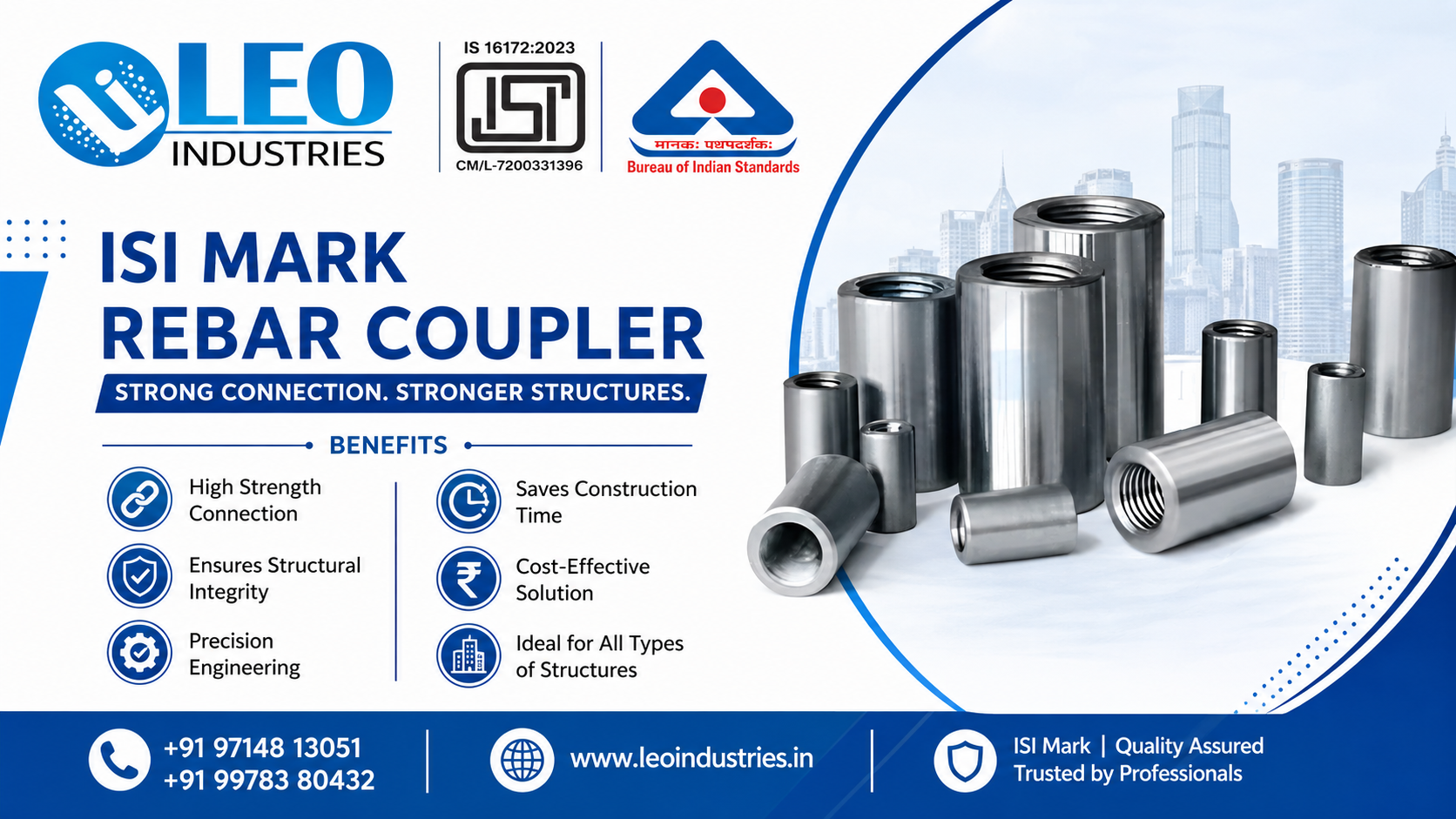
Benefits of Advanced Reinforcement Technology
Discover the benefits of advanced rebar coupler technology for stronger, more reliable construction in Ahmedabad. Learn about applications and selection.
What are Rebar Couplers? An Overview
Rebar couplers, also known as rebar splices or connectors, are mechanical devices used to join two reinforcing bars (rebars) together. Instead of the traditional method of overlapping rebars, which requires a significant length of overlap and can lead to congestion in dense reinforcement cages, couplers provide a direct, end-to-end connection. This is typically achieved through threading, swaging, or other mechanical joining processes that create a bond as strong as, or stronger than, the rebar itself. They are designed to transfer tensile and compressive forces efficiently between connected bars, ensuring structural continuity.
Key Features and Technical Specifications
Advanced rebar couplers are engineered with precision to meet stringent construction demands. Key features and specifications that differentiate them include:
- High Tensile Strength: Designed to exceed the yield strength of the rebar they connect, ensuring superior load-bearing capacity.
- Fatigue Resistance: Capable of withstanding repeated stress cycles without failure, crucial for structures subjected to dynamic loads.
- Corrosion Resistance: Available in materials and coatings that offer protection against environmental degradation, especially important in coastal or industrial areas.
- Ease of Installation: Many systems are designed for quick and simple installation, requiring minimal specialized tools or training.
- Versatile Sizing: Available to connect rebars of various diameters, including combinations of different sizes (reducer couplers).
- Material Compatibility: Manufactured from materials like high-grade steel (mild steel, stainless steel) to match the rebar being joined.
- Tapered or Parallel Threads: Offering different thread designs to suit specific installation requirements and load conditions.
- Full Mechanical Strength: Providing a direct, positive connection that eliminates the variability associated with lap splices.
Industrial Applications and Use Cases
The versatility of advanced rebar couplers makes them indispensable across a wide spectrum of construction applications:
- High-Rise Buildings: Essential for connecting rebar in columns and beams, especially where lap splices would create congestion and reduce concrete flow.
- Bridges and Flyovers: Providing robust connections for critical structural elements subjected to heavy traffic loads and environmental stresses.
- Industrial Plants and Heavy Machinery Foundations: Ensuring the integrity of foundations that support heavy equipment, requiring high tensile and fatigue strength.
- Tunnels and Underground Structures: Facilitating continuous reinforcement in confined spaces where overlapping is impractical.
- Precast Concrete Elements: Allowing for efficient and reliable connection of rebar in factory-produced components.
- Seismic-Resistant Structures: Offering superior performance under earthquake loads due to their high strength and ductility.
- Infrastructure Projects: Used in dams, retaining walls, and other large-scale civil engineering works requiring dependable reinforcement.
- Renovation and Retrofitting: Enabling the extension of existing structures or reinforcement of older concrete elements.
How to Choose the Right Rebar Coupler
Selecting the appropriate rebar coupler is critical for the success of any construction project. Consider these factors:
- Rebar Diameter and Grade: Ensure the coupler is designed for the specific diameter and grade of rebar being used.
- Load Requirements: Determine the tensile and compressive forces the splice will need to withstand.
- Environmental Conditions: Assess the need for corrosion resistance based on the project's location and exposure.
- Installation Space and Accessibility: Choose a coupler system that can be easily installed in the available space.
- Required Performance Standards: Verify that the coupler meets relevant national and international building codes and standards.
- Supplier Reputation and Experience: Opt for manufacturers with a proven track record in producing reliable couplers.
- Type of Splice: Decide between parallel, tapered, or other specialized thread types based on application needs.
- Availability of Reducer Couplers: If connecting different rebar sizes, ensure reducer options are available.
Quality Standards and Compliance
Ensuring that rebar couplers meet rigorous quality standards is non-negotiable for structural safety. Reputable manufacturers adhere to international standards such as ISO 9001 for quality management systems. In India, compliance with Bureau of Indian Standards (BIS) specifications, where applicable, is crucial. Couplers should be tested for tensile strength, fatigue resistance, and ductility according to codes like IS 13920 (Ductile Design and Detailing of Reinforced Concrete Structures Subjected to Seismic Forces) and other relevant international standards like ASTM or BS. Buyers should always request test certificates and ensure the product bears appropriate markings indicating compliance.
Why Leo Industries' Experience and Capability Matters
Established in 2015, Leo Industries in Ahmedabad, Gujarat, brings valuable experience to the manufacturing of rebar couplers. Our foundation is built on a deep understanding of engineering principles and the specific demands of the construction sector. We leverage a well-equipped manufacturing facility, including advanced machinery like CNC machines, rebar threading machines, and roll threading machines, to produce a wide range of couplers. Our capability extends to working with various materials, including different grades of stainless steel and mild steel, as well as specialized alloys.
Our team possesses the technical expertise to ensure precision in manufacturing and adherence to quality control at every stage. We understand the importance of reliable connections in critical infrastructure and building projects. This commitment to quality, combined with our manufacturing prowess and customer-centric approach, ensures that Leo Industries provides dependable reinforcement solutions tailored to the needs of the Ahmedabad construction market and beyond.
Installation, Maintenance, and Care Tips
Proper installation is key to realizing the full benefits of rebar couplers. Always follow the manufacturer's specific instructions for the chosen coupler type. Generally, this involves ensuring the rebar ends are properly prepared (cut square and free from damage) and that the threads are clean. For threaded couplers, hand-tightening followed by a specified torque using appropriate wrenches is usually required. Avoid over-tightening, which can damage the threads.
Maintenance for couplers themselves is minimal once installed, as they are protected within the concrete. However, during the construction phase, it's important to protect couplers and rebar ends from excessive dirt, debris, and potential damage. Regular visual inspection of installed couplers before concrete pouring can help identify any issues. For stainless steel variants, their inherent corrosion resistance requires no special care, but for mild steel couplers, ensuring they are adequately covered by concrete is the primary protection.
Frequently Asked Questions
The main advantage is creating a direct, full-strength mechanical connection that is more reliable and efficient than lap splicing. Couplers eliminate the need for extensive overlap, reducing rebar congestion, saving steel material, and improving concrete placement, especially in complex structural designs.
Yes, specialized reducer couplers are available that are specifically designed to join rebars of different diameters, providing a seamless transition of load between the bars. This offers significant flexibility in structural design and reinforcement detailing.
Common types include parallel thread couplers, tapered thread couplers, swaged or pressed couplers, and wedge-type couplers. Each type has specific installation methods and applications suited to different structural requirements and site conditions.
Advanced rebar couplers are engineered to meet stringent seismic performance requirements. They provide high tensile strength, ductility, and fatigue resistance, ensuring that structures can withstand the dynamic forces experienced during earthquakes without compromising structural integrity.
Yes, stainless steel rebars can be effectively joined using specialized stainless steel rebar couplers. These couplers are made from high-grade stainless steel alloys to ensure compatibility and maintain the corrosion resistance properties of the entire reinforcement system.
Look for suppliers who adhere to international quality management standards like ISO 9001. Additionally, verify that their products meet relevant national standards (e.g., BIS in India) and provide test certificates demonstrating compliance with specified mechanical properties like tensile strength and ductility.
Conclusion
Adopting advanced reinforcement technologies, particularly through the use of high-quality rebar couplers, offers substantial benefits for construction projects in Ahmedabad and beyond. These systems enhance structural integrity, improve construction efficiency, and contribute to safer, more durable buildings and infrastructure. When selecting couplers, it is essential to consider the specific project requirements, load conditions, environmental factors, and to partner with experienced, reputable manufacturers like Leo Industries who understand the critical role of reliable reinforcement solutions. By choosing wisely, developers and contractors can ensure their projects are built to last.
---
Get In Touch
Leo Industries