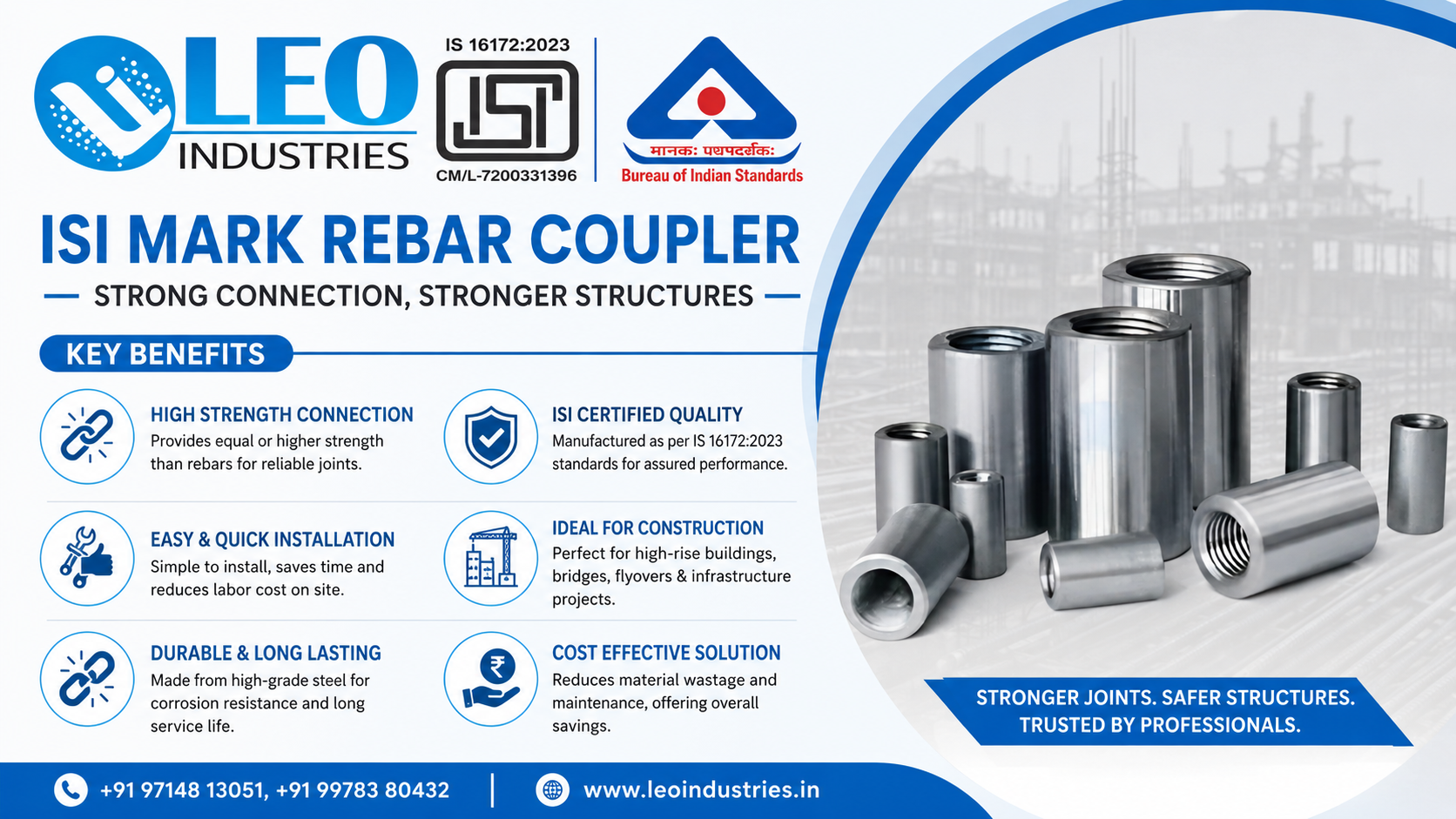
TMT Bar Coupler Manufacturer in India
Discover reliable TMT bar couplers from an experienced manufacturer in India. Ensure robust and durable connections for your construction projects with quality-
Why This Matters in India
India's rapid infrastructure development, encompassing everything from urban housing and commercial complexes to extensive road networks and industrial facilities, places significant demands on construction materials and techniques. Projects across Gujarat, including those in Ahmedabad, require solutions that can withstand diverse environmental conditions and meet stringent safety standards. Reliable TMT bar couplers are crucial for maintaining the continuity and strength of reinforcement in these large-scale endeavors, contributing directly to the longevity and resilience of the nation's built environment.
What Is a TMT Bar Coupler — Overview
A TMT bar coupler is a mechanical device designed to connect two Thermo-Mechanically Treated (TMT) reinforcing bars end-to-end, creating a continuous load path. Unlike traditional lapping, which relies on the bond between concrete and overlapping bars, couplers provide a full-strength connection that often exceeds the tensile capacity of the rebar itself. They work by securely gripping or threading the ends of the bars, eliminating congestion at splice points and ensuring a more predictable transfer of forces within the concrete structure.
Key Features and Technical Specifications
Choosing the right TMT bar coupler involves understanding its core technical attributes that contribute to structural performance. These features ensure the coupler integrates seamlessly and effectively into various construction designs.
- High Tensile Strength Retention: Engineered to maintain or exceed the strength of the connected TMT bars, preventing premature failure under stress.
- Fatigue Resistance: Designed to withstand repeated loading cycles, crucial for structures subjected to dynamic forces like bridges or high-rise buildings.
- Quick and Easy Installation: Facilitates faster assembly on-site, reducing labor costs and project timelines without compromising connection quality.
- Full Load Transfer Capability: Ensures a complete and efficient transfer of axial, tensile, and compressive forces between the connected rebars.
- Corrosion-Resistant Material Options: Available in various material grades, including stainless steel, to offer enhanced durability in aggressive environments.
- Compact Design: Minimizes congestion within concrete, allowing for easier concrete pouring and better compaction around the splice.
- Versatile Threading Types: Includes parallel and tapered thread options to suit different rebar types and project-specific connection requirements.
- Compliance with Standards: Manufactured to meet relevant national and international structural and material specifications.
Industrial Applications and Use Cases
TMT bar couplers are integral to a wide array of construction projects, offering significant advantages where traditional rebar lapping is impractical or insufficient. Their application spans various sectors, enhancing structural integrity and construction efficiency.
- High-Rise Buildings: Used extensively in columns, beams, and shear walls to manage rebar congestion and ensure continuous reinforcement.
- Bridge and Flyover Construction: Provides robust connections for critical structural elements, accommodating heavy loads and dynamic stresses.
- Metro Rail and Tunnel Projects: Essential for connecting reinforcement in underground structures, ensuring long-term stability and safety.
- Power Plants and Industrial Structures: Offers reliable connections in foundations and structural frameworks subjected to significant operational loads and vibrations.
- Precast Concrete Elements: Facilitates the connection of pre-manufactured concrete components, streamlining assembly and maintaining structural continuity.
- Water Retaining Structures: Utilized in dams, reservoirs, and tanks where leak-proof and durable reinforcement connections are paramount.
- Seismic Zone Construction: Enhances the ductility and integrity of structures, improving their performance during seismic events.
- Marine and Coastal Infrastructure: Stainless steel variants are employed to resist corrosion in harsh saline environments.
How to Choose the Right TMT Bar Coupler
Selecting the appropriate TMT bar coupler is a critical decision that impacts the safety, cost-effectiveness, and longevity of a construction project. Buyers should consider several key factors to ensure the chosen solution meets all project specifications.
- Project-Specific Requirements: Evaluate the type of structure, expected loads (tensile, compressive, seismic), and environmental conditions to determine the necessary coupler strength and material.
- Rebar Diameter and Grade Compatibility: Ensure the coupler is specifically designed for the diameter and grade of TMT bar being used in the project.
- Connection Type: Decide between parallel threaded, tapered threaded, or other mechanical splice systems based on installation preferences and structural demands.
- Material Certification: Verify that the coupler material, whether mild steel, high-strength alloy, or stainless steel (like SS316, SS304), meets specified standards and is suitable for the application.
- Supplier's Manufacturing Capabilities: Assess the manufacturer's ability to produce couplers consistently to precise tolerances and in required volumes.
- Quality Control and Testing: Inquire about the manufacturer's internal quality assurance processes and third-party certifications for their products.
- Technical Support and Documentation: Confirm the availability of detailed installation guides, technical data sheets, and expert support from the supplier.
- After-Sales Service: Consider the manufacturer's commitment to ongoing support, including troubleshooting and potential replacement parts.
- Customization Options: For unique project challenges, evaluate if the manufacturer can provide tailored coupler designs or material specifications.
Quality Standards and Compliance
Adherence to rigorous quality standards and compliance with relevant codes are non-negotiable for TMT bar couplers. These products are critical structural components, and their performance directly affects the safety and durability of the entire construction. Buyers should verify that couplers meet Indian Standards (IS codes) such as IS 16172:2014 for mechanical splices of reinforcing bars, which specifies performance requirements for tensile strength, slip, and fatigue. International standards like ISO 15835 also provide benchmarks for quality. Manufacturers should provide material test certificates, batch traceability, and evidence of regular quality control checks, including tensile testing, slip testing, and dimensional accuracy verification.
Why Company Experience and Capability Matters
The reliability of TMT bar couplers fundamentally depends on the expertise and manufacturing precision of the supplier. An experienced manufacturer understands the nuances of material science, machining tolerances, and structural engineering principles. Leo Industries, established in 2015 by Mr. Mahesh Patel and Mr. Yagnesh Patel, brings a focused approach to engineering products, including a comprehensive range of rebar couplers. Their capability is underpinned by a 1000 sq ft infrastructure in Ahmedabad, equipped with advanced machinery such as CNC machines, rebar forging machines, and rebar threading and roll-thread machines. This in-house capability allows for precise manufacturing from various materials like SS316, SS304, EN8, and even specialized alloys, ensuring consistent product quality and the ability to meet diverse project specifications. Their team's experience in production and quality control ensures that each coupler is manufactured to exacting standards, providing dependable connections for critical construction applications.
Installation, Maintenance, and Care Tips
Proper installation and handling are crucial for the optimal performance of TMT bar couplers. Following manufacturer guidelines ensures the mechanical splice performs as intended throughout the structure's lifespan.
- Surface Preparation: Ensure the ends of the TMT bars are clean, free from rust, oil, or concrete residue before threading or inserting into the coupler.
- Accurate Threading: If using threaded couplers, ensure the rebar ends are threaded precisely according to the coupler's specifications using appropriate threading machines.
- Correct Engagement: For mechanical couplers, ensure full engagement of the rebar into the coupler body, often indicated by visual markers or specific torque values.
- Torque Application: When required, use a calibrated torque wrench to apply the specified torque to the coupler bolts, ensuring a secure and consistent connection.
- Alignment: Maintain proper alignment of the connected rebars to avoid eccentric loading on the splice.
- Protection: After installation, protect exposed couplers from environmental elements, especially if they are not immediately encased in concrete.
- Storage: Store couplers in a dry, covered area, away from direct sunlight, moisture, and corrosive substances to prevent degradation before use.
- Inspection: Regularly inspect installed couplers during construction for any signs of damage, loosening, or improper installation.
Frequently Asked Questions
TMT bar couplers offer several benefits over traditional rebar lapping, including reduced rebar congestion, which allows for easier concrete pouring and better compaction. They also minimize material waste and provide a full-strength connection that is often stronger and more reliable than a lapped splice, especially in areas subjected to high seismic activity or dynamic loading. This results in more predictable structural performance and enhanced safety.
TMT bar couplers are highly versatile and suitable for a wide range of construction projects, from high-rise buildings and bridges to industrial structures and precast concrete applications. Their suitability depends on specific project requirements, rebar diameters, and load conditions. It is crucial to select the correct coupler type and material grade that aligns with the structural design and relevant engineering standards for each unique application.
TMT bar couplers are manufactured from various material grades to suit different strength and environmental requirements. Common materials include mild steel (M.S.), high-strength alloy steels like EN8 or EN31, and various grades of stainless steel such as SS304, SS316, or even Super Duplex for enhanced corrosion resistance. The choice of material depends on the project's structural demands and exposure to corrosive elements.
A reputable manufacturer ensures quality through stringent material sourcing, precise machining processes, and comprehensive quality control checks. This includes verifying raw material certifications, conducting in-process inspections for dimensional accuracy, and performing final product testing such as tensile strength tests, slip tests, and fatigue tests. Adherence to national and international standards like IS codes and ISO certifications further validates product reliability.
Yes, many experienced manufacturers offer customization options for TMT bar couplers to meet unique project specifications. This can include variations in material grade, thread type, length, or even specialized coatings for particular environmental conditions. Customization ensures that the couplers integrate perfectly with specific rebar sizes, structural designs, and performance requirements, providing tailored solutions for complex engineering challenges.
When properly installed and encased in concrete, a TMT bar coupler is designed to have a lifespan equivalent to or exceeding that of the reinforcing bar itself and the concrete structure. They are engineered for durability and resistance to environmental degradation. Factors like correct installation, appropriate material selection for the environment, and protection from corrosion within the concrete matrix contribute to their long-term performance and structural integrity.
Conclusion
The selection and implementation of TMT bar couplers represent a significant advancement in construction methodology, offering superior structural performance and efficiency compared to traditional rebar lapping. For any construction professional in India, understanding the technical specifications, quality standards, and the importance of partnering with a capable manufacturer is paramount. By prioritizing robust engineering, material integrity, and proven manufacturing expertise, projects can achieve enhanced safety, durability, and long-term value.
Get In Touch
Leo Industries