Leo Industries · Ahmedabad, Gujarat
Stainless Steel
Rebar Coupler
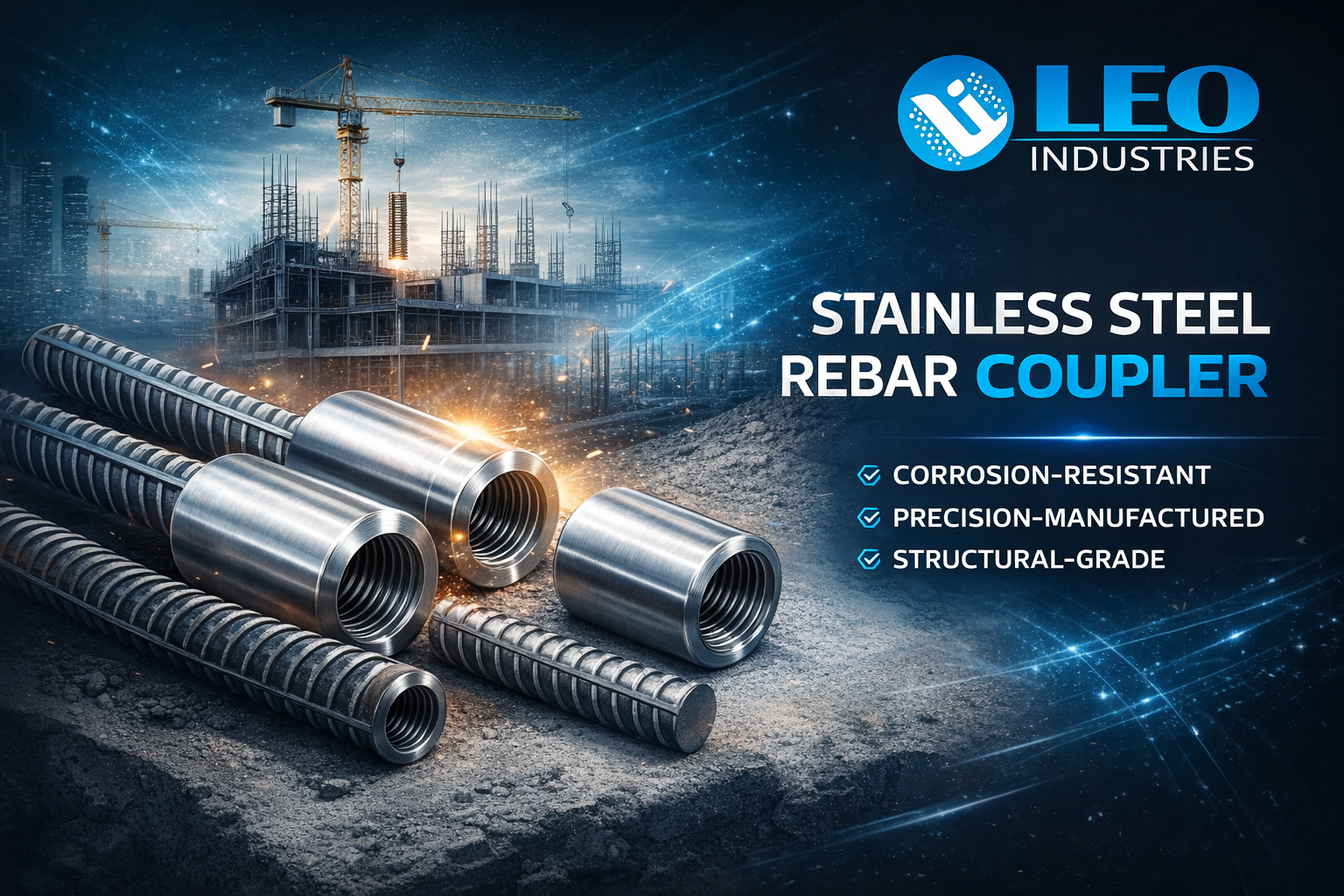
Reinforced concrete structures depend heavily on the strength and continuity of reinforcing bars. In modern construction practices, mechanical splicing methods are widely used to ensure secure and efficient bar connections. A Stainless Steel Rebar Coupler is an advanced mechanical connector designed to join reinforcing bars with high precision, strength, and durability.
Unlike traditional lap splicing methods, mechanical couplers enable direct bar-to-bar connections without overlapping reinforcement. This approach helps maintain structural integrity while optimizing the use of steel within reinforced concrete elements. Stainless steel construction adds an additional layer of corrosion resistance, making these couplers suitable for demanding environments where durability and reliability are essential.
Stainless Steel Rebar Couplers are commonly used in reinforced concrete frameworks where maintaining consistent load transfer and alignment between rebars is critical. Their design enables strong mechanical engagement between threaded reinforcement bars, ensuring that the structural continuity of the reinforcement system remains intact throughout the lifespan of the structure.
Section 02
Understanding Stainless Steel Rebar Couplers
A Stainless Steel Rebar Coupler is a mechanical connector engineered to join two reinforcement bars through threaded engagement. These couplers are manufactured from stainless steel to provide enhanced resistance to corrosion, environmental exposure, and long-term structural stress.
The coupler works by connecting the threaded ends of two reinforcing bars, allowing loads to transfer directly across the joint. This connection method eliminates the need for extended overlapping of reinforcement bars, which is traditionally required in lap splicing techniques.
In reinforced concrete construction, maintaining continuity between reinforcing bars is essential for effective load distribution within the structure. Mechanical couplers such as stainless steel rebar couplers provide a dependable alternative to conventional joining methods, especially in projects where space limitations, reinforcement congestion, or performance requirements demand a more efficient connection system.
Because stainless steel offers superior corrosion resistance compared to conventional steel materials, these couplers are particularly suitable for structures exposed to moisture, chemicals, or aggressive environmental conditions.
Section 03
Role of Mechanical Rebar Couplers in Reinforced Concrete Structures
Mechanical couplers play a vital role in modern reinforced concrete design. Their primary function is to create a secure connection between reinforcing bars while preserving the structural performance of the reinforcement system.
When reinforcement bars are joined using a mechanical coupler, the tensile forces acting on one bar are transferred directly to the adjoining bar through the coupler body. This allows the reinforcement to function as a continuous structural element within the concrete framework.
The use of stainless steel couplers further enhances the durability of the reinforcement system. Stainless steel is widely recognized for its resistance to corrosion, oxidation, and environmental degradation. As a result, stainless steel rebar couplers are frequently chosen for structures where long-term durability is a key design requirement.
Mechanical couplers also help simplify construction procedures by reducing reinforcement congestion and improving the efficiency of bar placement during structural assembly.
Section 04
Working Principle of Stainless Steel Rebar Coupler
The working mechanism of a stainless steel rebar coupler is based on threaded mechanical engagement between two reinforcing bars. Each bar end is prepared with a precisely machined thread that matches the internal thread profile of the coupler.
When the threaded bars are inserted and tightened into the coupler body, a strong mechanical connection is created. This connection allows both tensile and compressive loads to transfer efficiently from one bar to the other through the coupler.
The connection process typically involves the following steps:
Installation Steps
- 1Preparing reinforcement bar ends using threading equipment
- 2Cleaning and aligning the threaded bar ends
- 3Inserting the first threaded bar into the coupler body
- 4Tightening the second threaded bar into the opposite side of the coupler
- 5Ensuring full thread engagement for secure load transfer
This mechanical connection method provides reliable structural performance while maintaining the continuity required for reinforced concrete systems.
Section 05
Advantages of Stainless Steel Rebar Couplers
Mechanical couplers made from stainless steel offer several advantages for reinforced concrete construction projects. Their design improves structural reliability while simplifying reinforcement installation.
- Provides direct load transfer between reinforcement bars
- Eliminates the need for long lap splicing of reinforcement bars
- Reduces steel consumption in structural frameworks
- Improves reinforcement alignment and structural continuity
- Offers superior corrosion resistance compared to conventional materials
- Suitable for structures exposed to moisture or harsh environments
- Enhances overall construction efficiency and installation speed
Section 06
Applications of Stainless Steel Rebar Couplers
Stainless Steel Rebar Couplers are widely used in reinforced concrete construction where strong and durable bar connections are required. Their ability to maintain structural continuity and resist environmental degradation makes them suitable for a wide range of infrastructure and structural applications.
- ›High-rise building structures
- ›Bridge construction and transportation infrastructure
- ›Industrial reinforced concrete structures
- ›Water-retaining structures such as reservoirs and treatment plants
- ›Underground construction including tunnels and metro systems
- ›Infrastructure projects requiring corrosion-resistant reinforcement connections
Section 07
Why Mechanical Couplers Are Preferred in Modern Construction
The construction industry increasingly prefers mechanical couplers over traditional lap splicing methods because of the efficiency and structural benefits they provide. As construction projects become more complex, the need for precise reinforcement connections has grown significantly.
Mechanical couplers allow engineers and contractors to maintain reinforcement continuity while reducing steel congestion inside structural elements. This is particularly important in heavily reinforced sections such as columns, beams, and shear walls where multiple reinforcement bars must be arranged within limited space.
Another important advantage is improved construction efficiency. Mechanical couplers reduce the need for long overlapping reinforcement bars, which simplifies bar placement and improves on-site productivity.
When stainless steel materials are used in coupler manufacturing, the durability of the reinforcement system increases further. The corrosion resistance of stainless steel helps protect the connection from environmental exposure, making it suitable for structures designed for extended service life.
Section 08
Construction Considerations for Stainless Steel Rebar Couplers
When selecting and installing stainless steel rebar couplers, certain technical considerations are essential to ensure proper structural performance.
Engineers and construction professionals typically evaluate factors such as material compatibility, thread accuracy, and load-bearing capacity.
The threading process must be precise to ensure complete engagement between the coupler and reinforcement bars. Proper installation practices are equally important to achieve the intended mechanical strength of the connection.
Couplers should also be selected based on the diameter and grade of the reinforcement bars used in the structure. Ensuring compatibility between the coupler and the reinforcement system helps maintain the integrity of the reinforced concrete design.
Careful planning and quality control during installation contribute to reliable coupler performance in structural applications.
Conclusion
Conclusion
A Stainless Steel Rebar Coupler plays an important role in modern reinforced concrete construction by providing a reliable method for joining reinforcement bars. Through mechanical engagement, these couplers maintain structural continuity while reducing the need for traditional lap splicing.
Their corrosion-resistant stainless steel construction improves durability and makes them suitable for demanding structural environments. As infrastructure projects continue to require efficient reinforcement systems, stainless steel rebar couplers remain a practical and dependable solution for strong and precise rebar connections.
Frequently Asked Questions
A stainless steel rebar coupler is used to connect reinforcing bars in reinforced concrete structures. It creates a mechanical joint that allows loads to transfer directly between reinforcement bars while maintaining structural continuity.
A stainless steel rebar coupler works through threaded engagement between the coupler body and the threaded ends of reinforcing bars. Once tightened, the coupler forms a strong mechanical bond that transfers tensile and compressive loads across the joint.
Stainless steel is used because it provides excellent resistance to corrosion and environmental degradation. This makes stainless steel couplers suitable for structures exposed to moisture, chemicals, or harsh environmental conditions.
Lap splicing involves overlapping reinforcement bars so that loads are transferred through bonding within the surrounding concrete. Mechanical couplers directly connect the bars using threaded or mechanical engagement, which helps reduce steel usage and reinforcement congestion.
Yes, stainless steel rebar couplers are commonly used in infrastructure projects such as bridges, tunnels, and industrial structures where durability, structural reliability, and corrosion resistance are important considerations.
When properly designed and installed, rebar couplers maintain the structural performance of reinforcement systems by ensuring continuous load transfer between reinforcement bars.