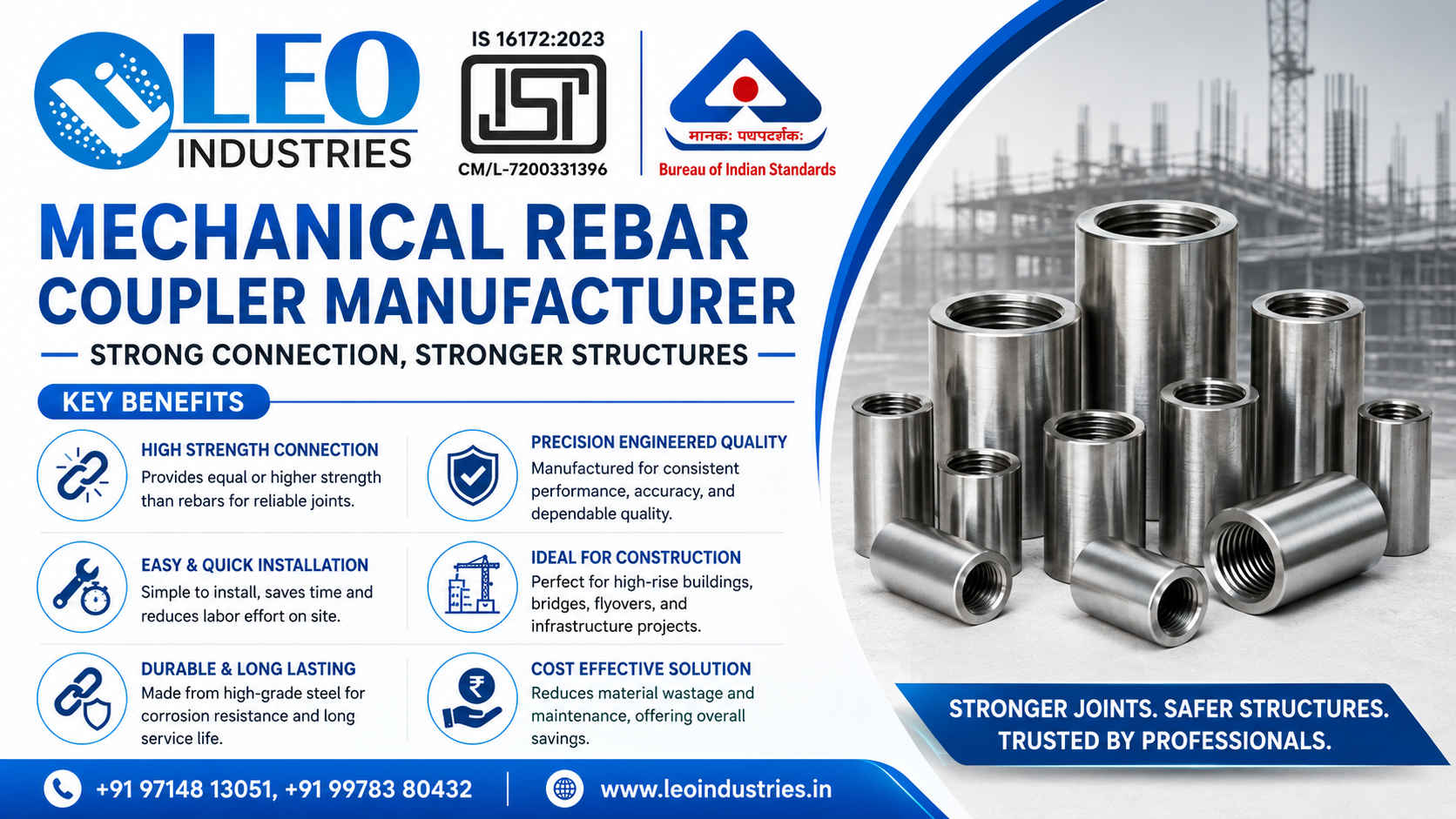
Mechanical Rebar Coupler Manufacturer
Leading mechanical rebar coupler manufacturer in Ahmedabad, Gujarat. Leo Industries offers high-quality TMT bar couplers for robust construction.
What is a Mechanical Rebar Coupler? — Overview
A mechanical rebar coupler is a device used to join two reinforcing steel bars (rebars) end-to-end. Instead of overlapping rebars, which consumes more steel and can create stress points, couplers create a direct, mechanical connection. This is typically achieved by threading the ends of the rebars and screwing them into a coupler sleeve, or by using specialized swaging or bolting mechanisms. The result is a continuous, load-bearing connection that is as strong as, or often stronger than, the rebar itself.
Key Features and Technical Specifications
- Material: Manufactured from high-grade steel (e.g., M.S., EN8, EN31) or stainless steel grades (SS316, SS316L, SS304) for corrosion resistance and strength.
- Thread Type: Available in parallel thread, tapered thread, or taper-thread designs to suit different rebar preparation methods.
- Connection Strength: Designed to achieve a tensile strength equal to or exceeding the characteristic yield strength of the rebar.
- Sleeve Design: Robust sleeve construction that ensures a secure and permanent bond between the rebar and the coupler.
- Corrosion Resistance: Options for galvanized or stainless steel couplers to protect against environmental degradation, crucial for long-term durability.
- Size Range: Accommodates a wide range of rebar diameters, typically from 8mm up to 40mm or more, to suit various project requirements.
- Ease of Installation: Designed for straightforward installation with minimal specialized tools, reducing labor time on-site.
Industrial Applications and Use Cases
- High-Rise Buildings: Essential for creating continuous reinforcement in multi-story structures, ensuring load transfer efficiency.
- Bridges and Flyovers: Provides critical structural integrity for large-span concrete elements, enhancing safety and longevity.
- Industrial Plants: Used in heavy-duty construction where robust connections are paramount for machinery foundations and structural supports.
- Infrastructure Projects: Vital for dams, tunnels, and underground structures requiring reliable rebar continuity under significant stress.
- Precast Concrete Elements: Facilitates the joining of precast sections, allowing for faster construction and improved quality control.
- Seismic Zone Construction: Offers superior performance in earthquake-prone areas by providing a stronger, more ductile connection than lap splices.
- Retrofitting and Repair: Enables efficient extension of existing rebar in renovation or repair projects without compromising structural integrity.
How to Choose the Right Mechanical Rebar Coupler
- Rebar Diameter and Grade: Ensure the coupler is designed for the specific diameter and grade of rebar being used.
- Type of Connection: Select between parallel, tapered, or other thread types based on rebar preparation capabilities and desired strength.
- Material and Corrosion Resistance: Consider the environmental conditions of the project site and choose appropriate materials (e.g., stainless steel for corrosive environments).
- Compliance and Certifications: Verify that the couplers meet relevant national and international construction standards (e.g., IS, ISO).
- Manufacturer's Reputation and Experience: Opt for suppliers with a proven track record in manufacturing high-quality couplers.
- Installation Requirements: Assess the ease of installation and any special tools or training required on-site.
- Load-Bearing Capacity: Confirm the coupler's ability to meet or exceed the required tensile and pull-out strength for the specific application.
- Supplier Support: Look for manufacturers who offer technical assistance and reliable after-sales service.
Quality Standards and Compliance
For any construction project, especially in a growing city like Ahmedabad, adherence to quality standards is non-negotiable. Reputable mechanical rebar coupler manufacturers ensure their products comply with stringent Indian Standards (IS) and international benchmarks like ISO. This includes rigorous testing for tensile strength, pull-out resistance, and fatigue performance. Buyers should always verify that the couplers they procure carry certifications and test reports demonstrating compliance with standards such as IS 1608 for mechanical properties of steel bars and relevant standards for splicing devices. This verification is crucial for ensuring the long-term safety and reliability of the constructed facility.
Why Leo Industries' Experience and Capability Matter
Established in 2015, Leo Industries in Ahmedabad brings nearly a decade of focused experience in manufacturing high-quality rebar couplers. Our strength lies in our in-house manufacturing capabilities, equipped with advanced machinery like CNC machines, rebar threading machines, and roll threading machines. This allows us to maintain precise control over the manufacturing process, ensuring every coupler meets exact specifications. Our team, guided by the expertise of Mr. Mahesh Patel and Mr. Yagnesh Patel, possesses deep knowledge of material science and engineering, enabling us to produce couplers from a wide range of steel and stainless steel grades. We understand the critical role these components play in structural integrity, and our commitment to quality assurance at every stage, from material sourcing to final inspection, makes us a reliable partner for your construction needs in Ahmedabad and beyond.
Installation, Maintenance, and Care Tips
Proper installation is key to realizing the full potential of mechanical rebar couplers. Ensure that the ends of the rebars are clean, free from rust or debris, and accurately threaded according to the coupler's specifications. For parallel threaded couplers, use a torque wrench to achieve the recommended tightening force, ensuring a secure connection without over-stressing the rebar or coupler. For taper-threaded types, ensure a snug fit.
Maintenance for installed couplers is minimal, as they are designed for permanent structural connections. However, during the construction phase, protect the couplers and exposed rebar ends from excessive moisture, dirt, and damage. If couplers are stored before installation, keep them in a dry environment to prevent corrosion. Regular visual inspections of the construction site can help identify any potential issues early on.
Frequently Asked Questions
Mechanical couplers create a direct, full-strength connection, eliminating the need for overlapping bars. This saves steel, reduces congestion in heavily reinforced areas, and provides a more predictable and consistent load transfer, which is crucial for structural integrity.
Yes, mechanical couplers are versatile and suitable for a wide range of projects, including high-rise buildings, bridges, industrial facilities, and infrastructure. They are particularly beneficial in seismic zones and for projects requiring high-strength connections.
Mechanical couplers are designed to join standard deformed reinforcing steel bars (rebars). They are available for various rebar diameters and grades, including mild steel and high-strength deformed bars commonly used in construction.
Always source couplers from reputable manufacturers who can provide product certifications, test reports demonstrating compliance with relevant standards (like IS or ISO), and material traceability. Inspect the couplers for any defects before installation.
For corrosive environments, it is recommended to use couplers made from stainless steel grades such as SS316 or SS316L, or those with specialized protective coatings. These materials offer enhanced resistance to rust and degradation.
When installed correctly and made from appropriate materials for the environment, mechanical rebar couplers are designed to last for the entire lifespan of the structure, typically 50 to 100 years or more, providing a permanent and reliable connection.
Conclusion
For construction projects in Ahmedabad and across Gujarat, selecting the right mechanical rebar coupler manufacturer is a decision that directly impacts structural safety and project efficiency. Leo Industries, with its established experience, in-house manufacturing capabilities, and commitment to quality, offers reliable splicing solutions. By understanding the technical specifications, application requirements, and the importance of compliance, builders can confidently choose couplers that ensure the long-term integrity and performance of their constructions.
Get In Touch
Leo Industries