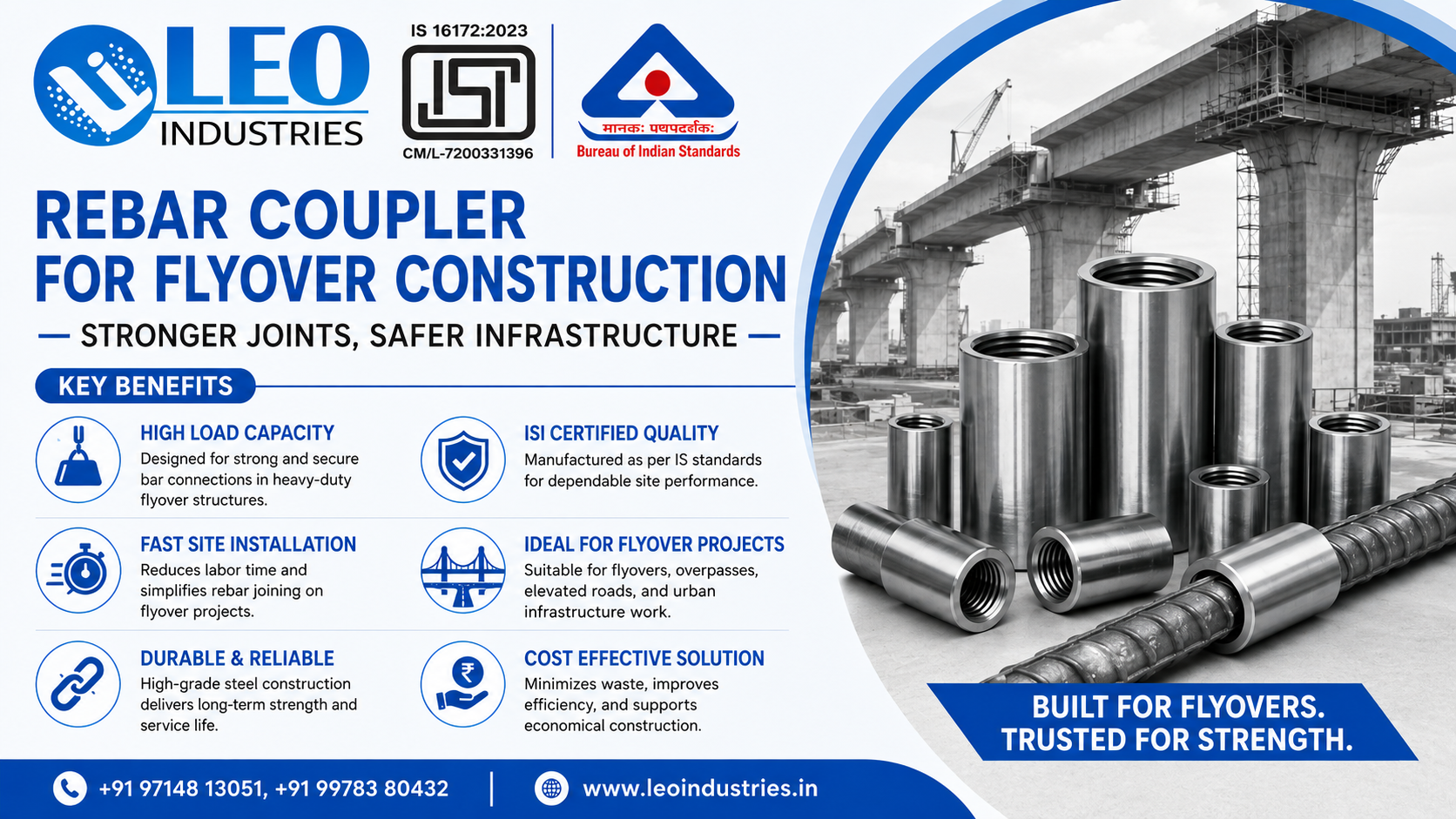
Rebar Coupler for Flyover Construction
Essential guide to rebar couplers for flyover construction in Ahmedabad. Learn about applications, selection, and quality standards with Leo Industries.
What is a Rebar Coupler? An Overview
A rebar coupler, also known as a rebar splice or mechanical splice, is a device used to connect two reinforcing steel bars (rebars) end-to-end. Instead of relying on traditional lap splicing, which requires overlapping bars and consuming more steel, couplers offer a more efficient and often stronger connection. They work by mechanically joining the rebars, typically through threading, swaging, or bolting mechanisms. This method ensures a continuous load path, transferring stress effectively from one bar to the next, which is essential for maintaining the structural integrity of large concrete elements like those found in flyovers.
Key Features and Technical Specifications
When selecting rebar couplers for demanding applications like flyover construction, specific technical attributes are critical for performance and reliability.
- Material Strength: Couplers must possess tensile and yield strength equal to or exceeding that of the rebars being joined.
- Thread Type: Options include parallel threads, tapered threads, and other specialized designs, each offering distinct advantages in grip and installation ease.
- Corrosion Resistance: Materials like stainless steel or specially treated carbon steel are vital for longevity, especially in environments prone to moisture or chemical exposure.
- Ease of Installation: Designs that minimize specialized tools or complex procedures can significantly speed up construction timelines.
- Bar Diameter Compatibility: Couplers are manufactured to precisely match specific rebar diameters, ensuring a secure and effective fit.
- Load Transfer Efficiency: The design should facilitate uniform stress distribution across the splice.
- Fatigue Resistance: Crucial for structures experiencing dynamic loads, such as those from vehicle traffic on flyovers.
Industrial Applications and Use Cases
The robust nature of rebar couplers makes them indispensable across various demanding construction sectors, with flyover construction being a prime example.
- Flyover and Bridge Decks: Providing continuous reinforcement for elevated roadways and bridge spans.
- High-Rise Buildings: Ensuring structural integrity in columns and beams subjected to significant vertical loads.
- Industrial Foundations: Creating strong, monolithic bases for heavy machinery and structures.
- Tunnels and Underground Structures: Maintaining reinforcement continuity in challenging subterranean environments.
- Precast Concrete Elements: Facilitating the efficient joining of prefabricated structural components.
- Seismic Zone Construction: Offering superior performance under dynamic seismic forces.
- Infrastructure Upgrades: Enabling seamless integration of new reinforcement in existing structures.
How to Choose the Right Rebar Coupler
Selecting the appropriate rebar coupler is a critical decision that impacts project safety, efficiency, and cost. Consider these factors carefully.
- Rebar Specifications: Match the coupler type and size precisely to the diameter, grade, and material of the rebars being used.
- Project Load Requirements: Assess the anticipated static and dynamic loads the splice will endure, ensuring the coupler meets or exceeds these demands.
- Environmental Conditions: Consider factors like moisture, temperature fluctuations, and potential chemical exposure, which may necessitate corrosion-resistant materials.
- Installation Method and Site Constraints: Evaluate the available space, labor skills, and required tools for installation. Some couplers are faster and simpler to install than others.
- Certifications and Standards: Verify that the couplers comply with relevant national and international construction standards (e.g., IS, ISO, ASTM).
- Supplier Reputation and Support: Choose a manufacturer with a proven track record, robust quality control, and reliable after-sales support.
- Cost-Effectiveness: While initial cost is a factor, consider the long-term benefits of durability, reduced labor, and enhanced structural integrity.
Quality Standards and Compliance
For any construction project, especially one as critical as a flyover, adherence to stringent quality standards and compliance with regulations is non-negotiable. Rebar couplers must meet established benchmarks to ensure they perform as intended under stress. In India, standards set by the Bureau of Indian Standards (BIS) are paramount. Manufacturers should be able to demonstrate compliance with relevant IS codes, such as IS 1608 for mechanical testing of steel products and specific codes related to rebar splicing.
Reputable manufacturers often pursue ISO certifications, like ISO 9001 for quality management systems, which indicates a commitment to consistent product quality and process control. Buyers should always request documentation verifying compliance with these standards and inquire about the testing procedures employed by the manufacturer. This due diligence ensures that the chosen couplers will contribute to the structural integrity and safety of the flyover, meeting the expectations of engineers and regulatory bodies in Ahmedabad and beyond.
Why Leo Industries' Experience and Capability Matters
Established in 2015 in Ahmedabad, Gujarat, Leo Industries brings a focused expertise to the manufacturing of rebar couplers. Our foundation is built on a deep understanding of the engineering requirements for critical infrastructure projects. We operate with a well-equipped infrastructural unit, housing advanced machinery like CNC machines, rebar threading machines, and roll threading machines, enabling precise manufacturing processes.
Our team possesses extensive knowledge in metallurgy and mechanical engineering, allowing us to work with a variety of materials, including different grades of stainless steel (SS316, SS316L, SS304) and mild steel (M.S., EN8). This capability ensures we can produce couplers tailored to specific project needs, whether for standard flyover applications or more specialized requirements. We pride ourselves on a rigorous quality control process, ensuring each coupler meets the demanding specifications required for reliable performance in projects across Gujarat and India.
Installation, Maintenance, and Care Tips
Proper installation and care of rebar couplers are essential to realize their full performance potential and ensure the long-term integrity of the structure.
- Cleanliness: Ensure both the rebar threads and the internal threads of the coupler are clean and free from debris, dirt, or grease before assembly.
- Thread Engagement: For threaded couplers, start threading by hand to ensure proper engagement and prevent cross-threading.
- Torque Specifications: If torque wrenches are recommended by the manufacturer, adhere strictly to the specified torque values to ensure a secure connection without over-stressing the components.
- Inspection: Visually inspect each connection after installation to confirm proper seating and alignment.
- Storage: Store couplers in a dry environment, protected from moisture and physical damage, to maintain their integrity before installation.
- Material Compatibility: Always use couplers designed for the specific rebar diameter and grade to ensure a perfect fit and load transfer.
Frequently Asked Questions
Rebar couplers offer a more efficient and often stronger connection compared to lap splicing. They eliminate the need for overlapping bars, reducing steel congestion, saving material, and speeding up the construction process, which is crucial for large-scale projects like flyovers.
Yes, rebar couplers are manufactured in a wide range of sizes and types to accommodate various rebar diameters and grades, including high-strength TMT bars commonly used in modern construction. It is essential to match the coupler precisely to the rebar specifications.
Ahmedabad's climate can involve humidity and varying temperatures. For flyovers, which are exposed to the elements, using couplers made from corrosion-resistant materials like stainless steel or those with protective coatings is advisable to ensure long-term durability and prevent degradation.
Look for couplers that comply with relevant Indian Standards (IS codes) and ideally have ISO certifications for quality management. Manufacturers should provide documentation confirming adherence to these standards, ensuring the product meets performance and safety requirements.
While some coupler types are simpler to install than others, most require basic tools and adherence to manufacturer guidelines. Threaded couplers, for instance, are relatively straightforward. Training for site personnel is often provided by manufacturers to ensure correct installation procedures are followed.
Rebar couplers provide a continuous and robust load path, which is critical for transferring seismic forces effectively through the reinforcement cage. This mechanical connection can offer superior performance under dynamic stress compared to traditional lap splices, enhancing the overall seismic resilience of the structure.
Conclusion
For critical infrastructure projects like flyovers in Ahmedabad, the selection of rebar couplers is a decision that directly impacts structural integrity, safety, and project timelines. Understanding the technical specifications, application suitability, and quality standards is paramount. Manufacturers like Leo Industries, with their experience in producing reliable rebar splicing solutions and commitment to quality, play a vital role in supporting the robust development of Gujarat's infrastructure. By choosing the right coupler and ensuring proper installation, engineers and contractors can build stronger, more durable, and safer flyovers for the future.
Get In Touch
Leo Industries