ISI Mark Rebar Coupler manufacturer in Gujarat
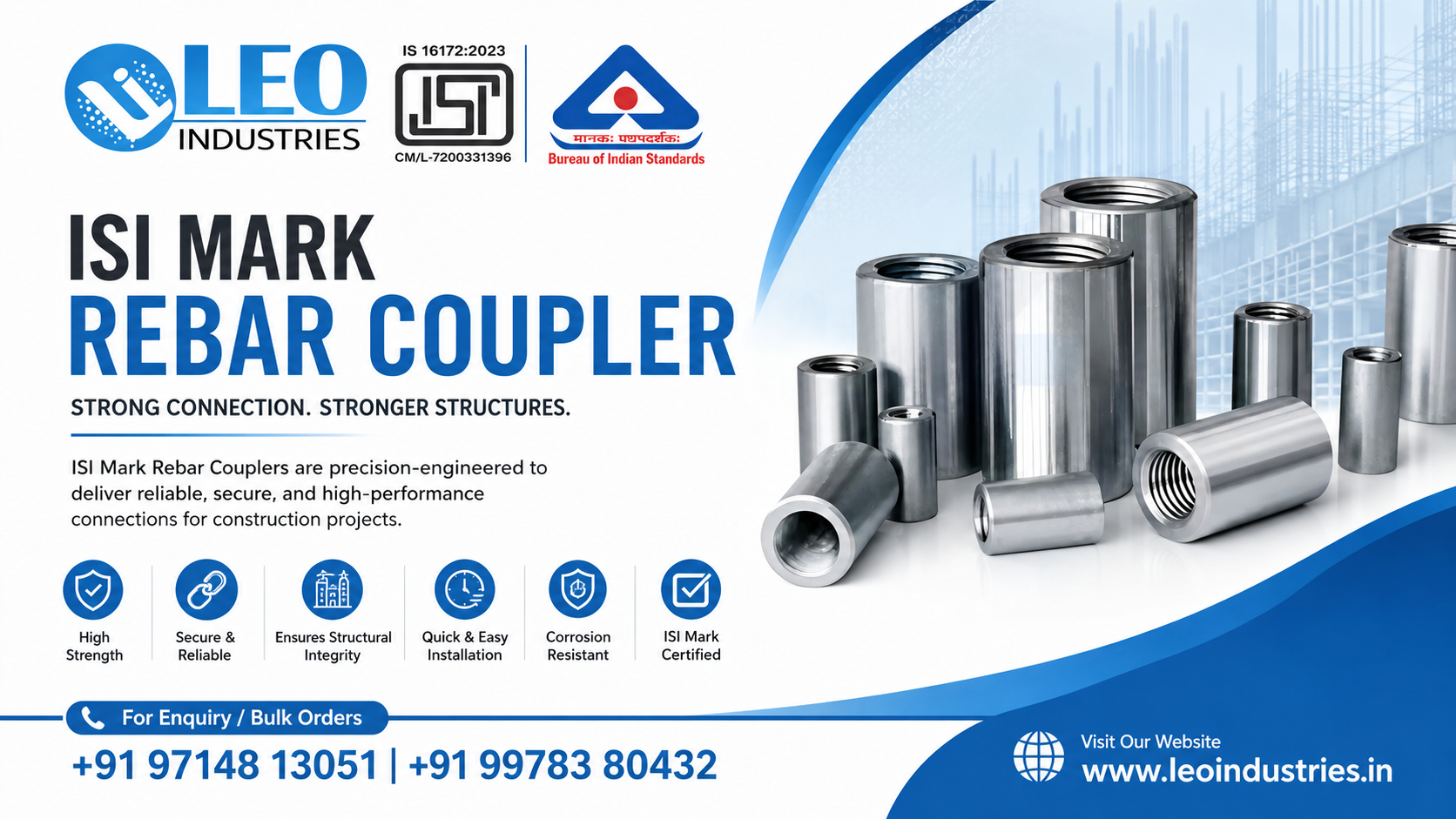
ISI Mark Rebar Coupler manufacturer in Gujarat
In the fast-evolving landscape of modern civil engineering and infrastructure development, the structural integrity of concrete frameworks is paramount. Ensuring that reinforcement bars (rebars) are perfectly joined is crucial to achieving this stability. This is exactly where high-quality rebar couplers play a revolutionary role. Replacing the traditional and outdated methods of lapping, these precision-engineered mechanical splices provide unparalleled load-bearing capabilities, structural continuity, and massive steel savings.
Established in 2015 in Ahmedabad, Gujarat, Leo Industries has positioned itself as a premier manufacturer, supplier, and exporter of advanced mechanical splicing systems. In this comprehensive guide, we will dive deep into the technology, applications, and profound benefits of integrating top-tier rebar couplers into your next mega-project.
Understanding High-Quality Rebar Couplers
A rebar coupler is a robust, hollow metallic cylinder designed with internal threads, used to connect two reinforcing bars end-to-end mechanically. Unlike traditional lap splicing—which requires overlapping two rebars side-by-side and binding them with wire—a mechanical coupler ensures that the load is transferred directly from one bar to another in a continuous straight line.
High-quality rebar couplers eliminate the concrete congestion caused by overlapping rebars. They are manufactured using premium-grade materials such as SS316, SS304, EN8, and EN31 to withstand extreme tensile stresses, ensuring that the joint is often stronger than the parent rebar itself. Whether it's a Tapered Thread Coupler, Parallel Threaded Coupler, or an MBT Rebar Coupler, the core objective remains the same: maximizing structural safety.
The Manufacturing Technology & Principle
The reliability of a rebar coupler depends entirely on the precision of its manufacturing. At Leo Industries, the fabrication process leverages state-of-the-art Computer Numerical Control (CNC) machinery to guarantee micron-level accuracy.
The Threading Principle: The ends of the TMT bars are enlarged (forged) and then precisely threaded using advanced Rebar Roll Threading Machines. The internal threads of the coupler are cut to match these exact specifications. When the bars are screwed into the coupler, the interlocking threads create a mechanical bond that prevents any slippage, even during seismic events.
Core Machining Capabilities
- High-Speed CNC Precision Machining
- Heavy-duty Rebar Forging
- CDRG Roll Threading Technology
- Advanced Horizontal Broaching
Key Features of Leo Industries Couplers
Not all couplers are created equal. Our products are engineered under stringent quality assurance protocols to deliver unmatched performance on the field. Here are the defining features of our high-quality rebar couplers:
Superior Material Grades
Manufactured from top-tier raw materials including Stainless Steel (SS316L, SS304) and Mild Steel (EN8, WPS), ensuring supreme resistance to corrosion and wear.
High Tensile Strength
Engineered to exceed the ultimate tensile strength of the parent TMT bar. In destructive testing, the failure always occurs outside the splice joint.
BIS & ISO Compliance
Our products strictly adhere to IS 16172:2023 standards. The Bureau of Indian Standards (BIS) mark guarantees safety, reliability, and project compliance.
Major Industrial Applications
Mechanical splicing systems are highly versatile and are mandated in various large-scale structural projects where safety factors cannot be compromised.
High-Rise Commercial Buildings
In skyscrapers, space is a luxury. Rebar couplers prevent congestion in heavily reinforced columns, allowing better flow of concrete and improving seismic resilience.
Bridges, Metros & Dams
Heavy infrastructure projects experience dynamic cyclic loading. Parallel and tapered threaded couplers ensure fatigue resistance and maintain structural integrity against heavy traffic and water pressure.
Why Make the Switch? The Core Benefits
Transitioning from lapping to mechanical splicing with high-quality rebar couplers is not just a technological upgrade; it is a smart financial and structural decision.
- Massive Steel Savings: Lapping requires wasting lengths of steel to overlap bars. Couplers connect them end-to-end, saving tons of expensive TMT steel per project.
- Solves Concrete Congestion: Overlapping bars make it difficult for concrete aggregates to pass through. Couplers keep the reinforcement grid clean, ensuring a flawless concrete pour without honeycombing.
- Faster Construction Cycle: Threading and coupling are much faster than manually binding overlapping bars with wire. It significantly reduces labor time and accelerates project completion.
- Superior Load Transfer: Mechanical splices behave as a continuous piece of steel, providing uniform distribution of tensile and compressive loads across the structure.
Why Choose Leo Industries?
Since our inception in 2015, under the visionary guidance of Mr. Mahesh Patel and Mr. Yagnesh Patel, Leo Industries has carved a niche in the engineering products market. Our expansive 1000 sq. ft. highly equipped infrastructure in Ahmedabad houses a dedicated team focused entirely on quality assurance and innovation.
We don't just manufacture; we engineer solutions. From sourcing premium raw materials to executing strict multidimensional quality checks, we guarantee products that deliver safety at competitive prices. Whether you need standard EN8 couplers or custom Super Duplex Stainless Steel fittings, our in-house CNC and milling setups ensure on-time, flawless delivery.
Frequently Asked Questions
Ready to Strengthen Your Infrastructure?
Connect with our engineering experts for bulk orders, technical queries, or custom manufacturing requirements.
Our Blogs
- Rebar Coupler for Dam Construction
- Rebar Coupler for High Rise Buildings in Ahmedabad | Leo Industries
- TMT Coupler for Road Construction
- Rebar Coupler for Industrial Foundation
- Rebar Coupler for Precast Construction
- Rebar Coupler for Tunnel Construction
- Rebar Coupler for Metro Rail Project
- Rebar Coupler for Flyover Construction
- Rebar Coupler for Bridge Construction
- Mechanical Splicing Coupler Supplier
- Mechanical Rebar Coupler Manufacturer
- Rebar Coupler for Construction
- Buy TMT Bar Coupler in India
- Buy Rebar Coupler in India
- MBT Coupler Price in India
- MBT Coupler Supplier in India
- TMT Bar Coupler Price in India
- TMT Bar Coupler Manufacturer in India
- Rebar Coupler Supplier in India
- Mechanical Splicing vs Traditional Methods
- Reinforcement Connection Methods Explained
- Benefits of Advanced Reinforcement Technology
- Complete Guide to Reinforcement Connections
- What Is Mechanical Splicing in Construction
- Civil Construction Products Ahmedabad
- Structural Components Manufacturer Ahmedabad
- Construction Engineering Products Ahmedabad
- Reinforcement Solutions Manufacturer in Ahmedabad
- ISI Mark Rebar Coupler manufacturing company
- ISI Mark Rebar Coupler manufacturer in India
- ISI Mark Rebar Coupler manufacturer in India
- ISI Mark Rebar Coupler manufacturer in Gujarat
- ISI Mark Rebar Coupler manufacturer in Gujarat
- ISI Mark Rebar Coupler manufacturer in Ahmedabad
- ISI Mark Rebar Coupler manufacturer in Ahmedabad
- Parallel Threaded Rebar Coupler manufacturing company
- Parallel Threaded Rebar Coupler manufacturer in India
- Parallel Threaded Rebar Coupler manufacturer in Gujarat
- Parallel Threaded Rebar Coupler manufacturer in Ahmedabad
- Tapered Thread Rebar Coupler manufacturing company
- Tapered Thread Rebar Coupler manufacturer in India
- Tapered Thread Rebar Coupler manufacturer in Gujarat
- Tapered Thread Rebar Coupler manufacturer in Ahmedabad
- Rebar Reducer Coupler manufacturing company
- Rebar Reducer Coupler manufacturer in India
- Rebar Reducer Coupler manufacturer in Gujarat
- Rebar Reducer Coupler manufacturer in Gujarat
- Rebar Reducer Coupler manufacturer in Ahmedabad
- MBT Rebar Coupler manufacturing company
- MBT Rebar Coupler manufacturer in India
- MBT Rebar Coupler manufacturer in Gujarat
- MBT Rebar Coupler manufacturer in Ahmedabad
- Rebar Coupler factory in Ahmedabad
- Rebar Coupler production company
- Rebar Coupler manufacturer in Gujarat
- BIS Certified Rebar Coupler manufacturer
- ISI Mark Rebar Coupler manufacturer
- Parallel Threaded Rebar Coupler Manufacturer in Ahmedabad
- Tapered Thread Rebar Coupler manufacturer
- Rebar Reducer Coupler manufacturer
- MBT Rebar Coupler manufacturer
- Rebar Coupler manufacturer
- ISI Mark Rebar Couplers in Gujarat
- BIS Certified Rebar Coupler Supply in India
- IS 16172 Standard Rebar Coupler Supplier in Gujarat
- Class H Rebar Coupler Manufacturer in India
- ISI Mark Rebar Couplers in Ahmedabad
- IS 16172 Standard Rebar Coupler Supplier in India
- BIS Certified Rebar Coupler Supplier in Ahmedabad
- Class H Rebar Coupler Manufacturer in Gujarat
- ISI Mark Rebar Couplers Manufacturer in Ahmedabad
- BIS Certified Rebar Coupler Supplier in India
- IS 16172 Standard Rebar Coupler in Gujarat
- Class H Rebar Coupler Manufacturer in Ahmedabad
- IS 16172 Standard Rebar Coupler in Ahmedabad
- ISI Mark Rebar Couplers Supplier in Gujarat
- IS 16172 Standard Rebar Coupler Manufacturer in India
- Class H Rebar Coupler in Gujarat
- BIS Certified Rebar Coupler Manufacturer in Ahmedabad
- BIS Certified Rebar Coupler Manufacturer in India
- Class H Rebar Coupler Supplier in India
- ISI Mark Rebar Couplers Manufacturer in Gujarat
- IS 16172 Standard Rebar Coupler Supply in India
- BIS Certified Rebar Coupler in Gujarat
- ISI Mark Rebar Couplers Supplier in Ahmedabad
- Rebar Coupler for RCC Construction
- Stainless Steel Rebar Coupler
- Rebar Coupler Supplier in Gujarat
- Rebar Coupler Manufacturer in Ahmedabad
- Construction Rebar Coupler Solutions
- Rebar Coupler for Bridges and Highways
- Rebar couplers for RCC structures
- Tapered Thread Rebar Coupler
- Rebar Coupler Supplier in Ahmedabad
- Rebar coupler manufacturer in India
- Stainless Steel Rebar Coupler Manufacturer
- Parallel Thread Rebar Coupler Supplier
- Tapered Thread Rebar Coupler Manufacturer
- TMT Bar Coupler Supplier in India
- Rebar Coupler Manufacturer in Ahmedabad
- Threaded Rebar Coupler Manufacturer
- Stainless Steel Rebar Coupler Manufacturer
- TMT Bar Coupler Manufacturer in Gujarat
- Rebar Coupler Manufacturer in Ahmedabad
- Mechanical Rebar Coupler Supplier India
- Reducer Pipe Fitting PVC
- Reducer Coupling Threaded
- Reducer Coupling Pipe Fittings
- Reducer Coupler Fittings
- Reducer Coupler Manufacturer
- Reducer Coupler Steel
- Reducer coupler pvc
- Tamper proof nut bolt
- Anti vandal bolts
- Security bolt Fixings
- Countersunk Shear Bolt
- Coupler Threading Machine
- Best parallel threaded tmt rebar coupler tmt bar coupler
- Parallel threaded tmt rebar coupler tmt bar coupler
- Best mbt rebar coupler
- Surya mbt rebar coupler
- Mbt rebar coupler manufacturers
- Mbt rebar coupler price list Guide
- Rebar Coupler manufacturers in India
- Best rebar coupler taper coupler parallel threaded coupler
- Rebar coupler taper coupler parallel threaded coupler price
- Rebar coupler taper coupler parallel threaded coupler pdf
- Rebar Couplers Manufacturer & Supplier from Rajkot India
- Rebar coupler sizes
- Rebar coupler pdf
- Rebar coupler types
- Rebar Coupler Price in India
- Rebar Coupler manufacturers
- Rebar Splices & Couplers
- Parallel Threaded Coupler Manufacturer in Jodhpur
- Rebar Reducer Coupler in Kalyan
- TMT Bar Coupler Manufacturers in Navi Mumbai
- Tapered Coupler Manufacturers in Khammam
- Parallel Threaded Coupler Manufacturer in Miryalaguda
- Rebar Reducer Coupler Manufacturers in Bhusawal
- Tapered Coupler Manufacturers in Jalna
- Rebar Reducer Coupler Manufacturers in Telangana
- TMT Bar Coupler Manufacturers in Nandyal
- MBT Coupler Manufacturers in Tenali
- TMT Bar Coupler Manufacturers in Bengaluru
- Parallel Threaded Coupler Manufacturer in Raichur
- MBT Coupler Manufacturers in Tiruvottiyur
- Rebar Reducer Coupler Supply in Kerala
- Tapered Coupler Manufacturers in West Bengal
- Stainless Stee
- Metal Coupler Manufacturer in Bikaner
- TMT Bar Coupler Manufacturers in Karnataka
- MBT Coupler Suppliers in Tiruvottiyur
- MBT Coupler Suppliers in Tamil Nadu
- Parallel Threaded Coupler Manufacturer in Karnataka
- Tapered Coupler Manufacturers in Karnataka
- MBT Coupler Manufacturers in Visakhapatnam
- Rebar Coupler Manufacturers in Raichur
- Stainless Steel Coupler Manufacturers
- Tapered Coupler Manufacturers in Vellore
- Mild Steel Coupler Manufacturer
- TMT Bar Coupler Manufacturer in Kerala
- Rebar Reducer Coupler Supplier
- TMT Bar Coupler Supplier in Suryapet
- Tapered Coupler Sangli
- MBT Coupler Warangal
- Rebar Reducer Coupler Manufacturer in Palakkad
- MBT Coupler Supplier in Tamil Nadu
- Parallel Threaded Coupler Manufacturer in Thrissur
- MBT Coupler Manufacturers in Madurai
- Rebar Reducer Coupler Manufacturer in Kerala
- Tapered Couplers in Sangli
- Rebar Reducer Coupler Manufacturer in Salem
- TMT Bar Coupler Manufacturer in Tumkur
- Stainless Steel Coupler Manufacturer in Raiganj
- Parallel Threaded Coupler Manufacturer in Thane
- Rebar Reducer Coupler in Kerala
- TMT Bar Coupler Manufacturer in Raiganj
- Rebar Reducer Coupler Manufacturer in Maharashtra
- Rebar Coupler Manufacturers in Jalandhar
- Supplier Submersible Pump Impeller Sleeve Gujarat Ahmedabad
- Stainless Steel Impeller Sleeve Submersible Gujarat
- Impeller Sleeve Submersible Pump Ahmedabad
- Impeller Sleeve Stainless Steel Submersible Supplier
- Impeller Sleeve for Submersible Pump Supplier
- Submersible Pump Impeller Sleeve Manufacturer
- mbt coupler manufacturers in kadapa
- rebar reducer coupler in parbhani
- rebar reducer coupler in thrissur
- tmt bar coupler manufacturers in bhilwara
- rebar reducer couplers in dungarpur
- mild steel coupler manufacturer in kerala
- rebar coupler manufacturers in maharastra
- tapered couplers in kerala
- Finding Top MBT Coupler Manufacturers in Tiruvottriyur
- Top Rebar Reducer Coupler Manufacturers Serving Sikar
- Premium Rebar Reducer Coupler Supply in Mumbai
- rebar coupler manufacturers in tamil nadu
- mbt rebar coupler manufacturer in andhra pradesh
- mild steel coupler manufacturer in delhi
- rebar coupler manufacturers in kolhapur
- MBT Rebar Coupler Manufacturer in Kerala
- MBTC Coupler Suppliers in Karnataka
- MBTC Coupler Manufacturers in Suryapet
- Leading Rebar Reducer Coupler Manufacturers in Jodhpur
- parallel threaded coupler manufacturers in khammam
- mild steel coupler manufacturers karnataka
- tmt bar coupler manufacturer in miryalaguda
- mbt coupler manufacturers in palakkad
- mbt coupler dealers in karnataka
- mbt coupler dealers in maharashtra
- rebar reducer couplers in kerala
- Tapered Coupler Manufacturer in Kerala
- Rebar Roller Threading Machine
- Rebar Pilling Blade for Roll Threading Machine
- Rebar Rib Peeling Blade for Thread Rolling Machine
- CDRG Roller for Roll Thread Machine | High-Performance Tooling
- CDRG Rebar Roll Thread Roller – Automation Grade
- CDRG Threading Machine Supplier in Ahmedabad
- CDRG Threading Machine Supplier in Gujarat
- CDRG Threading Machine Manufacturer in Gujarat
- CDRG Threading Machine Manufacturer
- CDRG Threading Machine (Roll Threading Machine)
- CDRG Roller for Roll Thread Machine
- 20mm mbt rebar coupler manufacturer in sabarkantha
- MBT Coupler Manufacturers in Jharkhand
- parallel threaded coupler manufacturers in kalyan
- tapered coupler manufacturer in tamil nadu
- Tapered Coupler Manufacturer in Tamilnadu
- Tapered Coupler Manufacturer in Uttarakhand
- Rebar Reducer Coupler in Tamil Nadu
- Parallel Threaded Coupler Manufacturers in Maharashtra
- Mild Steel Coupler Manufacturer in Khammam
- TMT Bar Coupler Manufacturer in Satara
- Rebar Reducer Coupler Manufacturers in Mumbai
- Mild Steel Coupler Manufacturer in Sangli
- Tapered Coupler Manufacturer in Bhusawal
- Stainless Steel Coupler Manufacturer in Sikar
- TMT Bar Coupler Manufacturers in Maharashtra
- Mild Steel Coupler Manufacturer in Tiruchirappalli
- Parallel Threaded Coupler Manufacturer in Gulbarga
- Rebar Coupler Manufacturer Serving Assam & Vellore
- Rebar Coupler Manufacturer in Assam
- MBT Couplers
- 32x25mm Reducer Coupler
- 25x20mm Reducer Coupler
- 20x16mm Reducer Coupler
- Reducer Coupler
- Lock Shear Bolt
- 16mm, 20mm, 25mm Rebar Coupler
- Metal Couplers
- 32 mm EN8D Steel TMT Rebar Coupler
- 25 mm EN8D Steel TMT Rebar Coupler
- 20x16 mm EN8D Steel TMT Rebar Coupler
- Rebar Coupler Taper Coupler Parallel Threaded
- Rebar Coupler – Taper Coupler & Parallel Threaded Coupler
- 16 x 12 mm Reducer MBT Coupler
- 16 x 12 mm Reducer MBT Coupler
- 25 x 20 mm MBT Rebar Coupler
- 20mm MBT Rebar Coupler
- 12mm MBT Rebar Coupler
- 16mm MBT Rebar Coupler
- 25mm MBT Rebar Coupler
- MBT Rebar Coupler
- 16 mm EN8D Steel TMT Rebar Coupler
- 20mm EN8D Steel TMT Rebar Coupler
- 16mm EN8D Steel TMT Rebar Coupler
- Mild Steel Rebar TMT Coupler
- Rebar Coupler | Taper Coupler | Parallel Threaded Coupler
- Rebar Reducer Coupler
- Rebar Reducer Coupler
- 12MM TMT Bar Coupler
- 16MM TMT Bar Coupler
- Rebar Coupler Manufacturers in Gujarat
- Rebar Coupler manufacturers in India
- Tmt Rebar Coupler Manufacturers Near Me
- Tmt Rebar Coupler Manufacturers in India
- TMT Rebar Coupler Manufacturers in India
- 12mm TMT Bar Coupler
- Rebar Coupler Manufacturers in Rajkot
- 16mm TMT Bar Coupler
- Best TMT Rebar Coupler Manufacturers in India
- Rebar Coupler Manufacturers in Gujarat
- Top 10 TMT Rebar Coupler Manufacturers in India
- Impeller Collet Sleeve Manufacturers in India
- Top 10 TMT Rebar Coupler Manufacturers in India
- Impeller Collet Sleeve for Solar Pump
- Impeller Collet Sleeve for Solar Pump
- Impeller Collet Sleeve for Solar Pump
- Impeller Collet Sleeve Manufacturers in India
- Impeller Collet Sleeve for Submersible Pump in India
- Impeller Collet Sleeve for Submersible Pumps
- impeller collet sleeve manufacturer
- Impeller collet sleeve for submersible pump
- Impeller Collet Sleeve Price
- Impeller Collet Sleeve
- TMT Rebar Coupler Manufacturers in India
- Top TMT Rebar Coupler Manufacturers in India
- Rebar Coupler Supplier
- Rebar Coupler Manufacturers in India
- Rebar Coupler Manufacturers in Rajkot
- Rebar Coupler Manufacturers in India
- Top Rebar Coupler Manufacturers in India
- Top 10 Rebar Coupler Manufacturers in India
- Rebar Coupler Manufacturers in Gujarat
- Rebar Coupler Manufacturers in India
- Rebar Coupler Price
- Types of rebar Couplers
- Rebar Coupler Manufacturers in Hyderabad
- Steel rebar coupler manufacturers in india
- Rebar coupler manufacturers near me
- Rebar Coupler manufacturers in Rajkot
- Rebar Coupler manufacturers in gujarat
- Rebar coupler manufacturers in india
- rebar coupler manufacturers